FDBM

Architecture Despite The Stream

Philosophy-Indexed History of Science and Architecture

UNDER DEVELOPMENT Portal content and features are still being developed.
I · Natural Phase II · Perception Phase III · Understanding Phase IV · Desire Phase V · Reason Phase VI · Spirit (Geist) Phase
UNDER DEVELOPMENT Portal content and features are still being developed.
100%
Natural Phase Map · Explore Headings on the Map
100% Disciplines

PHILOSOPHY

600 BCE DAO SCHOOL

The teaching of Dao (the Way), which may also be thought of as bringing together knowledge accumulated since hunter-gatherer times, has among its most important representatives Lao Zi in the 6th century BCE and Zhuang Zi in the 4th century BCE. It proposes grasping and following the main flow of the universe, expressing the idea that “where Dao is abandoned, virtue comes to the fore; where virtue is abandoned, morality; and where morality is abandoned, justice.” (Wikipedia/Daoism)

In Chapters 18 and 38 of the Daodejing, as harmony with the Dao weakens, forms of conduct that previously did not need to be named because they were already present gradually become explicit norms such as de (virtue / efficacious power), ren (humaneness), yi (rightness), and li (ritual / social propriety). This can be read not as suggesting that virtue was created later, but rather that forms of conduct already sustained within a way of life aligned with the natural course of things came to require explicit teaching, naming, and regulation as that harmony weakened.
(Daodejing, Chapters 18 and 38; Chinese Text Project.)

Could “ritual and calendar” reproduce harmony with nature without instrumentalizing it, while the same mechanism, once centralized, could become instrumentalized? (C.A.P III, pp. 6–7/42)

Details

It may be regarded as one of the schools that most strongly influenced Chinese society and thought. Daoist understanding had important effects on areas such as explanations of the cosmos, foundations of Chinese medicine, and conceptions of how nature works. It arose in China and influenced many traditions of thought.

Source check / note: While retaining the FDBM4 narrative, it seems more accurate not to think of the “Dao School” as a sharply bounded school founded by a single historical figure in 600 BCE. On closer examination, there are different views concerning the historicity of Laozi and the formation date of the Daodejing; the text may have developed through a long process of formation. On the other hand, the sources appear to agree on the strong and long-lasting influence of Daoist thought in China.

Source: Youlan Feng, 1983, A History of Chinese Philosophy, Vol. I, pp. 170–191 (Laozi) and pp. 221–245 (Zhuangzi).
Comparative note: Alan K. L. Chan, 2025, “Laozi”, Stanford Encyclopedia of Philosophy, especially §§1–2.

Interpretation: I think reading Dao as a continuation of knowledge accumulated since hunter-gatherer times, and considering ritual-calendar relations in terms of centralization/instrumentalization, are interpretations developed within the Cities From Antiquity to the Present III framework.

Source ↗

563–483 BCE GAUTAMA BUDDHA

The philosophy of Gautama Buddha may be summarized as directing the individual, through reason, away from the perceived world and its effects toward truth and mental freedom. According to Buddha, there are two kinds of truth: 1- Conventional truth. 2- Ultimate truth.

Details

Although his awakening began within the ascetic traditions of India and later developed along his own distinctive path, his philosophy was transmitted for a period through stories in oral culture and was written down and developed only later. For this reason, it cannot always be attributed to him in every detail; it may be more accurate to say that later teachings proceeded from his teaching. There are many philosophies said to have developed from Buddha’s teaching.

His foregrounding of awakening in this period may be important both as a philosophy that reaches beyond its own time and as a search for solutions to social conditions that emerged as population density reached a certain point. The Western term “enlightenment” is used in the Far East in the sense of awareness or awakening. According to Buddha, liberation is the maturation by which a human being no longer needs to return again and again to this world in order to learn.

This process of maturation—which may briefly be described as reason first gaining mastery over emotions and senses through techniques such as yoga and meditation, then the subject gaining mastery over its own mind, and beyond that—may perhaps be compared with the theory of intellects in the ontology of Al-Farabi in the 900s CE, where beings are classified according to the superiority of intellects over one another; and later, in the first half of the twentieth century, with M. Merleau-Ponty’s approach, which suggests that our existence is not merely sexual, merely spatial, or merely temporal, but that these dimensions are interconnected within embodied existence.

On the other hand, although Buddha also taught that what he taught should not simply be accepted without reasoning, it remains a subject of discussion today whether the teachings of Buddha—and likewise teachings preceding the Greek enlightenment or school, including Confucius—should be regarded as philosophy in the sense of being based on rational inquiry.

Source check / note: I retain the FDBM4 distinction between conventional and ultimate truth. However, on closer examination, the distinction in the systematic form in which it is known today does not appear explicitly in the earliest texts and seems to have been developed especially in later Abhidharma and Madhyamaka traditions. It may therefore be more cautious to read it as a distinction grounded in Buddhist teaching and systematized in later Buddhist philosophy.

I also think the connection I make with Merleau-Ponty is better understood not as a claim of direct historical influence, but as a comparative connection in thought. On closer examination, Merleau-Ponty does not define existence as merely sexual, merely spatial, or merely temporal; rather, spatiality, sexuality, and temporality appear as interconnected dimensions of embodied being-in-the-world.

Source: Rupert Gethin, 1998, The Foundations of Buddhism, pp. 35–58 (oral transmission, texts and schools), pp. 59–84 (Four Truths, suffering and nirvana).
Mark Siderits, 2007, Buddhism as Philosophy, pp. 15–31 (early Buddhism), pp. 180–207 (Madhyamaka).
Maurice Merleau-Ponty, 2002, Phenomenology of Perception, pp. 112–202 (body, space and sexuality), pp. 476–501 (temporality).

Source ↗

551–479 BCE CONFUCIUS

Confucius, living in approximately the same historical period as some of the pre-Hellenistic Greek philosophers, proposed a philosophy whose central concern was the virtuous person and a society living in harmony. In order to reach this ideal;

Details

it was necessary to define the virtuous person and to help such a person emerge through ritual. Concepts and phenomena such as the other world, God, spirits and supernatural beings do not occupy the central place in his teaching. In this respect, his approach may be compared in some ways with Socrates in Greek philosophy.

The philosopher known in the West as Confucius, K’ung-fu-tzu, proposed an ethical philosophy based on principles of appropriate conduct. Before Confucianism, Chinese rulers governed through principles that assumed a direct relationship between power and punishment. Confucius argued that good government was connected with adherence to tradition. The ideal Confucian man had to earn the right to authority through strict self-criticism and self-renewal; the cultivation of music and the arts was also important. Zhou rulers had used “ritual” as a marker of aristocratic conduct, and later state practice incorporated some Confucian ideas into ritual and religious life.

In Confucius’s teaching, the development of the person through learning, self-criticism, ritual (li), humanity/benevolence (ren) and appropriate conduct—and the reflection of this process in family and social order—appears to be a fundamental line of thought.

Source check / note: FDBM4 stated that Confucius came “before the pre-Hellenistic philosophers.” Historically, he did not precede all of the early Greek natural philosophers; he lived in roughly the same centuries as some of them. For this reason, only this chronological relation was corrected.

Source: Youlan Feng, 1983, A History of Chinese Philosophy, Vol. I, pp. 43–75.
Philip J. Ivanhoe & Bryan W. Van Norden, 2005, Readings in Classical Chinese Philosophy, pp. 1–58.

Source ↗

6th–3rd centuries BCE HUNDRED SCHOOLS OF THOUGHT

Hundred Schools of Thought: During this period, currents of thought arose in the Far East in what has been called the Golden Age of Chinese philosophy.

Details

Source check / note: The name “Hundred Schools of Thought” can be used to describe the emergence of many different intellectual circles during the same broad period. However, on closer examination, it seems that these should not be understood as exactly one hundred sharply bounded schools in the modern sense; many classifications were constructed retrospectively in later periods.

Source: Youlan Feng, 1983, A History of Chinese Philosophy, Vol. I, pp. 132–169.

Source ↗

700–500 BCE PRE-HELLENISTIC PERIOD — NATURAL PHILOSOPHERS

Pre-Hellenistic Natural Philosophers (before 323 BCE), or the period of Ancient Greek philosophy, around 700–500 BCE, was a period of mythos (legend and oral culture). In this period, knowledge consisted of inherited stories about creation, being and the human, and was obtained through intuition. Knowledge began to acquire value as a problem in itself, beyond its immediate usefulness in daily life; in this sense, one may suppose that a tradition resembling knowledge for its own sake began to emerge.

Details

Probably before Thales and Pythagoras helped establish a world of abstract thought through mathematics, the boundaries between disciplines had not yet developed, especially in the Archaic period (800–480 BCE), when philosophy was not yet treated independently from other fields. Thinkers later called philosophers therefore also pursued practical inquiries. Andrea Nightingale characterizes them as “pragmatic and polymathic.” For example;

Source check / note: I retain the FDBM4 narrative of a “mythos period.” However, on closer examination, it seems more accurate to speak not of a single, abrupt break from mythos to rational/natural explanation, but of explanatory forms that coexisted for some time and gradually differentiated. What I am chiefly looking for here seems to be the transformation by which knowledge began to be investigated for its own sake, beyond immediate everyday use.

Source: Geoffrey S. Kirk, John E. Raven & Malcolm Schofield, 1983, The Presocratic Philosophers, pp. 7–75 (precursors of philosophical cosmogony and the transition toward philosophy).
Andrea W. Nightingale, 2004, Spectacles of Truth in Classical Greek Philosophy, Cambridge University Press.

Source ↗

624–545 BCE THALES

Thales, regarded as the first philosopher, together with Pythagoras, helped establish the world of abstract thought through mathematics. He is known as an initiator of the Ionian Enlightenment.

Details

He is the first of the Seven Sages of ancient Greece and is called a pioneer of philosophy and science. He displayed abilities in astronomy, engineering, politics, agriculture and commerce. He was involved in trade and, according to later tradition, was in Egypt.

The Ionian Enlightenment refers to developments in scientific thought, explanations of nature and the search for causes behind phenomena beginning in Archaic Greece in the 6th century BCE, whereas in the Far East the word “enlightenment” is used in the sense of a kind of awareness or awakening. In this sense an awakened person is called a “Buddha.”

Source check / note: The description of Thales as the first philosopher is a strong tradition in histories of philosophy. However, it seems better to read the claim that mathematics alone “created” abstract thought not as a strict causal statement, but as part of FDBM’s way of reading development across disciplines. Biographical details such as Thales’s journey to Egypt and his involvement in trade also come from later ancient sources and should therefore be treated cautiously.

Source: Geoffrey S. Kirk, John E. Raven & Malcolm Schofield, 1983, The Presocratic Philosophers, pp. 76–99.

Source ↗

570–480 BCE PYTHAGORAS

Pythagoras and his students believed that everything was related to mathematics, that numbers were ultimate reality, and that through mathematics everything could be predicted and measured.

Details

Because his period was one of oral culture, legend and myth, information about him rests largely on later transmission and legendary narratives. Nevertheless, the influence of Pythagoras and his school can be seen in later writings and teachings. Aristotle, for example, states that Plato’s philosophy was to a considerable extent dependent on Pythagorean teaching. Plato may also have drawn from the Pythagorean tradition the idea that mathematics and abstract thought could provide a secure foundation for philosophy, science and ethics. Nature was thought to be founded upon abstract mathematics and number. The greatest scientific achievements of the Pythagoreans were in astronomy.

Source check / note: I retain the FDBM4 narrative; however, on closer examination, Pythagoras left no writings of his own, and many strong formulations such as “everything is number” reach us through the later Pythagorean tradition and Aristotle’s reports. It therefore seems more accurate to read the claim that “numbers are ultimate reality” as a general summary of Pythagorean thought rather than as a verbatim statement by Pythagoras himself.

Source: Geoffrey S. Kirk, John E. Raven & Malcolm Schofield, 1983, The Presocratic Philosophers, pp. 214–238.
Walter Burkert, 1972, Lore and Science in Ancient Pythagoreanism, especially pp. 28–96 (Aristotle and the later source tradition), pp. 337–368 (Philolaus’s cosmology).

Source ↗

569–477 BCE XENOPHANES

Xenophanes adopted a principle of causal explanation. His philosophy was read by Karl Popper as an early precursor of critical rationalism, and as suggesting that one may proceed on the basis of working hypotheses without assuming that one possesses certain truth.

Details

Source check / note: Popper’s reading of Xenophanes as an early precursor of critical rationalism can be clearly verified. However, this is not a concept used by Xenophanes himself; it is Popper’s modern interpretation. The statement that Xenophanes “adopted the principle of causality” did not appear in the sources with the same clarity. I therefore think it is more cautious to relate this to Xenophanes’s tendency to explain natural phenomena within nature rather than through arbitrary divine intervention, rather than treating it as the name of a clearly formulated doctrine.

Source: Geoffrey S. Kirk, John E. Raven & Malcolm Schofield, 1983, The Presocratic Philosophers, pp. 163–180.
Karl Popper, 1998, The World of Parmenides, “The Unknown Xenophanes”, p. 33 ff.
Robin Attfield, 2014, “Popper and Xenophanes”, Philosophy 89(347), pp. 113–133.

Source ↗

535–475 BCE HERACLITUS

Heraclitus thought that the essence of everything was fire and associated wisdom, the highest virtue, with fire. He foregrounded logos and ideas of relativity. According to Heraclitus of Ephesus;

Details

the only unchanging reality is change, and one cannot bathe twice in the same river. Heraclitus was also influenced by the Milesian philosophers. “Moderation is the greatest virtue. Wisdom is to speak the truth and act according to nature, listening to it.”

Heraclitus had a strong influence on later ancient philosophers. Sophists such as Protagoras were influenced by Heraclitus’s doctrine that everything flows and by ideas of relativity. The Stoics also followed Heraclitean ideas. His later influence extends to Montaigne, Hegel, Nietzsche, Jung and Russell.

Source check / note: “Everything flows” and “one cannot step into the same river twice” are powerful and well-established summaries of Heraclitus’s thought. However, on closer examination, the river fragments seem to concern continuity and the unity of opposites as much as change, and “relativity” is not Heraclitus’s own term in the modern sense. Fire too can be read not merely as a material first substance, but together with the order of transformation. I therefore think it is better to retain the FDBM4 narrative while noting the interpretive character of these formulations.

The direct source for the FDBM4 statement attributed to Marcus Aurelius—that one should not fully accept the opinions of others—could not be verified. Rather than preserving it as a direct quotation, it seems more cautious to place it within the broader influence of Heraclitus on Stoicism.

Source: Geoffrey S. Kirk, John E. Raven & Malcolm Schofield, 1983, The Presocratic Philosophers, pp. 181–212.
A. A. Long (ed.), 1999, The Cambridge Companion to Early Greek Philosophy, “Heraclitus”, pp. 88–112.

Source ↗

515–460 BCE PARMENIDES

Parmenides, who thought that the eternal and everlasting One was everything, argued that the senses create illusion and that reality is this permanent One. Although the mystical Parmenides distinguished the rational from the sensory, he presented his knowledge as received intuitively from a goddess of the underworld. According to Parmenides, dialectic is a method of thinking through concepts alone.

Details

Source check / note: The FDBM4 account of the “unchanging One” and the distinction between the senses and reason seems consistent with one of the most influential readings of Parmenides. However, on closer examination, academic discussion continues concerning the relation between the “Truth” and “Opinion/Appearance” parts of the poem. I therefore think some caution is needed before treating the sensory world as nothing but “illusion” or strict monism as the only possible interpretation.

The definition “dialectic = a method of thinking through concepts alone” also seems to belong more to later histories of philosophy than to Parmenides’s own terminology. By contrast, the fact that the poem begins with a goddess narrative and presents reasoning within this poetic/revelatory frame belongs directly to the structure of the text.

Source: Geoffrey S. Kirk, John E. Raven & Malcolm Schofield, 1983, The Presocratic Philosophers, pp. 239–262.
A. A. Long (ed.), 1999, The Cambridge Companion to Early Greek Philosophy, “Parmenides and Melissus”, pp. 113–133.

Source ↗

500–428 BCE ANAXAGORAS

Anaxagoras defined Nous (Cosmic Mind) as the mind that sets everything in motion, alongside the idea that everything is in everything. He thought that our senses cannot show us reality directly, but argued that visible things can provide knowledge about invisible things.

Details

Source check / note: An important distinction seems necessary here. Anaxagoras’s nous is the mind/intellect that initiates and orders cosmic motion. “Everything in everything,” however, is not directly a definition of nous, but part of his doctrine of material mixture. In FDBM4 the two formulations stood side by side and could be read as if one defined the other; I think it is better to retain the narrative while making this distinction explicit.

Despite the weakness of the senses, the idea that “appearances are a sight of the unseen” seems particularly interesting for FDBM’s history of knowledge, because it allows visible phenomena to serve as the starting point for inference about processes that cannot themselves be directly seen.

Source: Geoffrey S. Kirk, John E. Raven & Malcolm Schofield, 1983, The Presocratic Philosophers, pp. 352–384.
A. A. Long (ed.), 1999, The Cambridge Companion to Early Greek Philosophy, “Empedocles and Anaxagoras: Responses to Parmenides”, pp. 159–179.

Source ↗

460–370 BCE DEMOCRITUS

Democritus, with a consciously materialist approach, explained perception and thought as movements of the finest, lightest and smoothest fire-atoms in the body.

Details

Source check / note: It is well supported that Democritus treated perception and thought within an atomist explanation of nature. However, “materialist” was not a school-name used by Democritus himself; it is a retrospective term used today to classify his approach. I therefore think the FDBM4 phrase “consciously materialist” is better read as a modern classification.

Source: Geoffrey S. Kirk, John E. Raven & Malcolm Schofield, 1983, The Presocratic Philosophers, pp. 402–433.
A. A. Long (ed.), 1999, The Cambridge Companion to Early Greek Philosophy, “Soul, Sensation and Thought”, pp. 250–270.

Source ↗

490–430 BCE ZENO

Zeno: the monist understanding, and motion and change as illusion. He developed the view of his teacher Parmenides that only Being is unchanging reality and tried, through indirect arguments exposing logical difficulties in opposing positions, to show the impossibility of change against those who maintained the reality of plurality and change.

Details

Source check / note: Reading Zeno’s paradoxes as arguments designed to defend Parmenides has been a strong tradition since Plato. However, on closer examination, the paradoxes also appear to open philosophical problems in their own right concerning divisibility, infinity, space and motion. I therefore think it is better to retain the Parmenidean connection in FDBM4 without seeing Zeno merely as someone who repeated his teacher’s position.

Source: Geoffrey S. Kirk, John E. Raven & Malcolm Schofield, 1983, The Presocratic Philosophers, pp. 263–279.
A. A. Long (ed.), 1999, The Cambridge Companion to Early Greek Philosophy, “Zeno”, pp. 134–158.

Source ↗

469–399 BCE SOCRATES

According to Socrates, the human being (soul), before coming into this world, possessed knowledge innately, and what we call learning in this world consisted of recollection (and inference).

Details

Source check / note: Here it seems necessary to complete the FDBM4 account with an important distinction. The doctrine that “learning = recollection” (anamnesis) reaches us especially through Plato’s Meno and Phaedo, in the mouth of the character Socrates. It therefore seems more accurate to present it not as an independently and securely documented doctrine of the historical Socrates, but as a view developed by Plato through Socrates.

The geometrical questioning episode in the Meno is also particularly important for FDBM: instead of giving the answer directly, Socrates tries, through questions, to enable the learner to see the relation for himself.

Source: Jane M. Day (ed.), 2003, Plato’s Meno in Focus, pp. 22–34 (Meno paradox and recollection), pp. 88–111 (anamnesis), pp. 112–128 (learning as recollection).

Source ↗

470–385 BCE PHILOLAUS

Philolaus, emphasizing the primary position of number as an unavoidable criterion of intelligibility, argued that “everything known has a number; for without this it is impossible for anything to be thought or known.” (P. PESIC 2014)

In Philolaus, number serves not only calculation but also the intelligibility of things; this can later be traced in Archytas’s treatment of astronomy, geometry, arithmetic, and music together as four related mathēmata — literally, “learnable things.” Pesic notes that Plato placed these fields of knowledge at the center of an education leading from the perceived world toward a more abstract form of understanding:

“Archytas took Philolaus’s ideas as the basis of what he called the four mathēmata, literally ‘learnable things’: astronomy, geometry, ‘numbers’ (arithmetic), and music. These four are united because ‘their concern is with the two primary forms of what is, which are sisters themselves,’ by which Archytas may have meant the realms of the visible and the audible. In his Republic, Plato put these four at the center of the education that leads to what he called ‘philosophy,’ which he depicted as a journey from the shadowy illusions of perception to the full light of reality that shines beyond the dark cave we call ‘the world.’ This quest requires harmony in both body and soul, for which Plato prescribes the combined practice of mousikē and gymnastikē, which is not merely acrobatics or calisthenics but the living embodiment of mousikē in the moving body. He uses the expression ‘to rhythmize’ as a synonym for education.” (P. Pesic 2014)

In this period, “philosophy” seems not yet to have been an autonomous discipline separated from the others in the modern sense, but rather a broader path of inquiry directed toward knowing and wisdom through the combined use of different fields of knowledge. (Pesic 2014) (SEP/Archytas)

Details

Source check / note: This item is strongly supported in the form used in FDBM4. Philolaus’s Fragment 4 explicitly states that known things have number and that without number nothing can be thought or known. However, this does not necessarily mean that “everything is made only of numbers”; rather, number appears especially as a condition for things to be knowable and intelligible.

I think this distinction also helps us read in greater detail the general statement “everything is number” used in the Pythagoras item.

Source: Geoffrey S. Kirk, John E. Raven & Malcolm Schofield, 1983, The Presocratic Philosophers, pp. 322–351.
A. A. Long (ed.), 1999, The Cambridge Companion to Early Greek Philosophy, “The Pythagorean Tradition”, pp. 66–87; discussion of Philolaus B4 appears in this section.

Source ↗

ARITHMETIC

Mathematics as a Product of Pure Reason
One distinguishing feature of mathematics is its ability to produce necessary conclusions by logical deduction from specified definitions and assumptions. Its history, however, does not begin from “pure reason” alone: practices of counting, measurement, calendrics, land administration, trade, and observation of the sky were also fundamental to the emergence of mathematical thinking. For the Natural Phase, the key point is that recurring patterns and quantities in nature gradually became countable, comparable, and measurable. (Stanford Encyclopedia of Philosophy; Robson 2008)
Details
The FDBM heading “Mathematics as a Product of Pure Reason” is a conceptual heading emphasizing that proof and deduction can establish a kind of necessity different from empirical confirmation; it should not be read as claiming that historical mathematics arose independently of experience and practical life.

Arithmetic concerns numbers and operations on them; algebra concerns unknown quantities and relations among quantities; trigonometry concerns relations between angles and lengths. Complex numbers and calculus are much later historical developments and do not belong directly to the Natural Phase. They are retained here only as a modern orientation to the wider field of mathematics.
Arithmetic
Arithmetic is the study of numbers and numerical relations. For the Natural Phase, the important step is not only counting objects but also recognizing ratios among quantities as regular relations. In ancient Greek natural philosophy, the relation between number, ratio, and music became especially important in the Pythagorean tradition; Peter Pesic describes music as a meeting place between number and perception. (Pesic 2014, MIT Press)
Details
Pesic draws attention to the historical proximity between Homeric legein (“to gather”) and meanings of logos associated with ratio, account, and reasoning. He then suggests that musical intervals such as 1:2, 2:3, and 3:4 make relations among whole numbers perceptible. This is not established historical evidence that arithmetic “originated” in music, but a deliberately interpretive thesis advanced by Pesic. For FDBM, its value lies in making visible the transition between abstract ratio and sensory experience. (MIT Press)
Algebra
Old Babylonian scribes used systematic step-by-step procedures to solve problems that we would now express as linear or quadratic equations. Calling these procedures “algebra” is a useful modern shorthand, but the Babylonians did not write symbolic equations in the modern sense. (MacTutor – Quadratic equations; Robson 2008)
Details
In problems concerning the area and sides of rectangles, Old Babylonian procedures can be compared—using modern language—to completing the square. It is therefore more accurate to say that Old Babylonian texts contain algorithmic problem-solving procedures that we can describe as algebraic than to say simply that “the Babylonians invented algebra.” The Egyptian Rhind Mathematical Papyrus likewise contains arithmetic, fractions, area and volume problems, and problems that we would now express as simple equations. (British Museum – Rhind Mathematical Papyrus)
Historical Process
The earliest surviving written mathematical traditions in Mesopotamia and Egypt appear together with everyday and institutional practices such as counting, accounting, measurement, land administration, distribution, calendrics, and scribal education. Independent traditions of number and measurement also developed in India, China, and the Americas. For the Natural Phase, the decisive transformation is the gradual conversion of time, space, and quantity in nature into a measurable order. (Robson 2008; British Museum)
Details
This process should not be understood as a linear story in which “mathematics was invented” in a single center and then simply diffused outward. Annette Imhausen, for example, stresses that Egyptian and Mesopotamian mathematical knowledge formed part of the basis for later Greek mathematics, while the relations cannot be reduced to a simple one-way line of transmission. (Imhausen 2024, Oxford)

From the FDBM perspective, the following question can be retained: Could “measurement,” while making natural rhythms—land, water, crops, and time—visible, also have transformed them into a manageable scheme? This is not presented as an established historical fact but as an FDBM research question carried over from Kent III. (A.Ç.G. Kent III, p.6/42)
14th century BCE → Number and Calculation in China
Late Shang oracle bones (roughly thirteenth to eleventh centuries BCE) preserve not only divinations but also numerical records concerning casualties, captives, sacrifices, hunted animals, days, and months. Written numerals used a decimal multiplicative-additive structure. By about the fourth century BCE, decimal place-value notation with counting rods had become a powerful material tool for calculation, moving beyond the mere recording of quantities. (Springer – Whole Number Arithmetic; Cambridge – Late Shang oracle bones)
Details
A characteristic feature of early Chinese mathematics is the development of numerical computation and procedures rather than an axiomatic structure of proof in the later Greek style. The Suan shu shu (Book of Numbers and Computation), from a tomb dated to about 200 BCE, is among the earliest surviving detailed written evidence for mathematical problem solving in China. The later Nine Chapters systematized methods involving fractions, proportions, root extraction, areas and volumes, and simultaneous linear equations. (Katz & Parshall 2014; Volkov 2018, Oxford Handbook)

For FDBM, the important transition is from recording quantities in nature and social life to turning them, through counting rods and algorithmic procedures, into an operable order.
3rd millennium BCE → Number, Measure, and Calculation in India
Standardized weights, length scales, and regular brick ratios from Indus Valley cities show that everyday production, trade, and building in the third millennium BCE rested on a strong culture of quantity and measurement. Since the Indus script remains undeciphered, however, these objects should not be turned into a detailed theory of arithmetic without textual evidence. In the Vedic period (roughly 1500–500 BCE), numbers were expressed in a decimal structure, sometimes extending to very large quantities. (Divakaran 2018; Knudsen 2018, Oxford Handbook)
Details
For the early history of arithmetic in India it is useful to distinguish two levels: material practices of measurement and the later culture of number visible in texts. Standardized weights and rulers from the Indus civilization indicate the coordination of measurement over a wide area. Vedic literature uses decimal number names and very large numbers; the Śulba-sūtras (roughly 800–200 BCE), although primarily geometrical, also show increasingly sophisticated uses of calculation, ratio, and approximation. (Knudsen 2018)

The chronology of decimal place value and zero should not be forced into a single very early date; accordingly, the later major achievements of Indian mathematics are not projected backward onto the Indus period here. For the Natural Phase, the minimal and robust conclusion is that measure, ratio, and number moved from material practices toward increasingly abstract systems of calculation.
Development Chart of Mathematics
The earlier FDBM image on the development of mathematics can be retained as a schematic visualization that helps recall relations among fields, but it should not be treated as an academic chronology or genealogy.

Schematic visualization of the development of mathematics
Earlier attribution: Matematiksel.org / Facebook post. Historical verification here relies on the academic sources below rather than on this diagram.
Details
For the Natural Phase, a more reliable and simpler developmental scheme can be read in five steps:
1. Everyday practices of counting and measurement → 2. written systems of number and measure → 3. standardized computational procedures in scribal schools → 4. algorithmic problem solving in Old Babylonia → 5. increasingly abstract treatments of number, ratio, geometry, and proof in the Greek world.

This is not a claim of a single linear “progression”; simultaneous and independent developments occurred in different cultures. Compare: Old Babylonian scribal mathematics, Rhind Mathematical Papyrus, Egypt–Greek relations, Mathematics in India until 650 CE.
from c. 3000 BCE Numerical Writing in Mesopotamia
Around 3000 BCE in Mesopotamia, writing, record keeping, and calculation developed together, and numerical signs became part of administrative and economic documentation. In later Babylonian mathematics, a sexagesimal place-value system became a powerful computational tool. The earlier label “Chaldeans, 3000 BCE” has been corrected chronologically: Chaldeans are attested in southern Babylonia only from the early ninth century BCE. (Encyclopaedia Iranica; MacTutor)
Details
Early Mesopotamian and Babylonian numerical writing used combinations of basic cuneiform signs for units and tens, while a sexagesimal place-value notation developed over time. The early system did not possess a zero digit in the modern sense; placeholder signs for an empty place appeared much later. The earlier FDBM statement that the system used “three signs: 0, 1, and 10” is therefore incorrect. (MacTutor – Babylonian numerals)

In Egypt, from around 3000 BCE, a separate non-positional decimal system used distinct hieroglyphic signs for powers of ten such as 1, 10, 100, and 1000. This represents a different developmental line from Mesopotamian notation. (MacTutor – Egyptian mathematics)
c. 1800–1600 BCE Babylon
Old Babylonian clay tablets contain sophisticated methods involving sexagesimal calculation, numerical tables, square-root approximations, and problems that we would now express using linear or quadratic equations. Numerical entries on Plimpton 322 are interpreted by many scholars in relation to Pythagorean triples, although the tablet’s exact purpose remains debated. (Robson 2008; MAA – Plimpton 322)
Details
It is therefore safer to narrow the statement “the Babylonians knew the Pythagorean theorem”: Babylonian mathematicians used numerical relations among the sides of right triangles and could generate Pythagorean triples, but the surviving evidence does not justify simply equating this with the later Greek form of a general theorem accompanied by deductive proof. (MAA)

The Indian Śulba-sūtras (approximately 800–200 BCE), in the context of altar geometry, contain explicit use of the relation later called the Pythagorean theorem. This is another indication that similar mathematical relations developed in different cultural settings. (Oxford Handbook – Mathematics in India)
c. 200–284 CE Diophantus
Diophantus of Alexandria treated unknown quantities and numerical problems in a more systematic notation in his Arithmetica, and is therefore sometimes called the “father of algebra.” The label, however, oversimplifies a much longer history: Babylonian and Egyptian texts contain equation-like problems and solution procedures many centuries earlier. (MacTutor – Diophantus; British Museum – Rhind Papyrus)
Details
The dating of Diophantus is uncertain; MacTutor gives approximately 200–284 CE. The British Museum dates the Rhind Mathematical Papyrus to about 1550 BCE and describes 84 problems involving division, multiplication, fractions, areas, and volumes. The earlier statement about “single-unknown algebra in 1650 BCE” has therefore been reformulated without directly imposing modern algebraic terminology on the ancient text.

Note: Diophantus is chronologically later than the main early range of the Natural Phase. He is retained here comparatively, to show how numerical problem-solving developed toward a more systematic algebraic language.

GEOMETRY

All Early Geometries
Early geometric understanding may be explored through practices such as distinguishing shapes, finding direction, measuring, and constructing buildings. These relationships can be examined within lived experience, without assuming that geometry had already emerged as a separate field of knowledge.

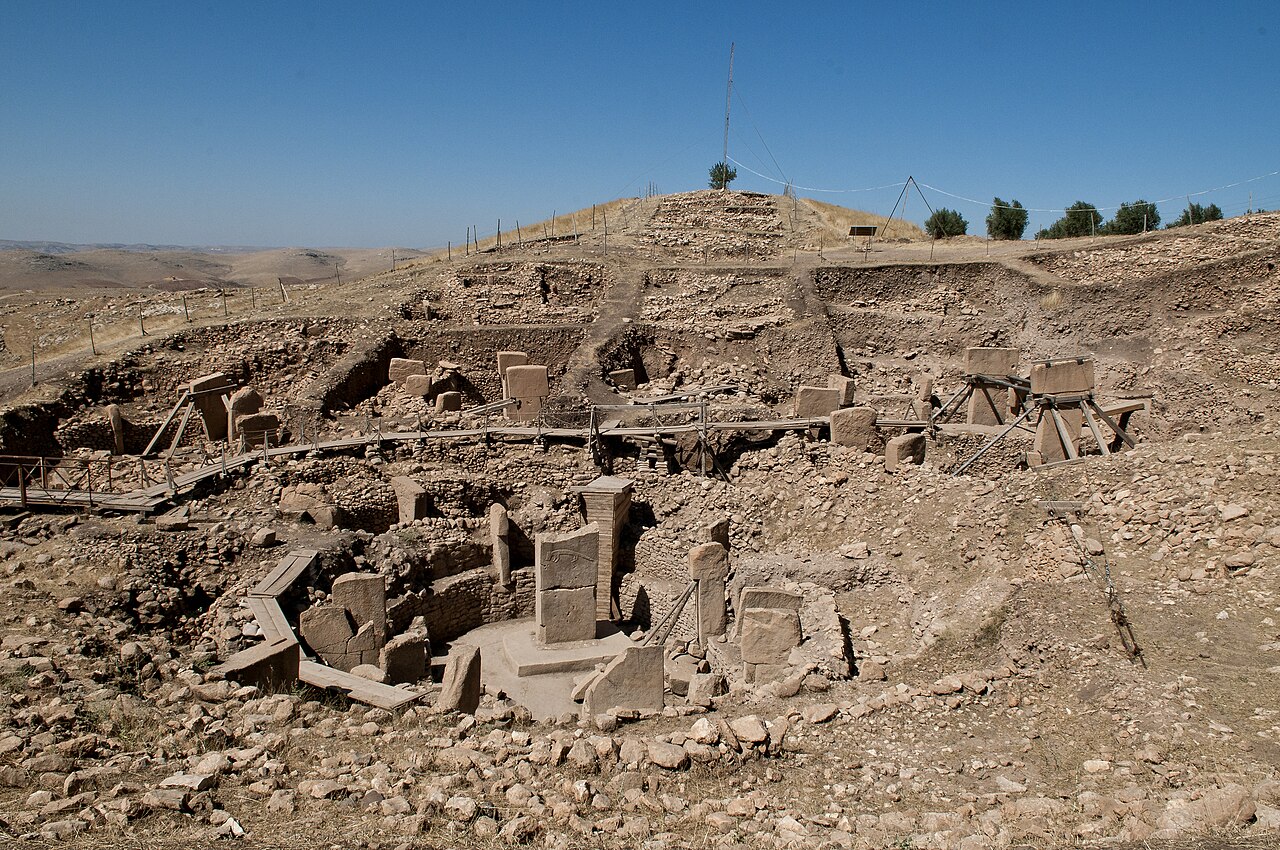
A geometric analysis of Enclosures B, C and D at Göbekli Tepe suggests that coordinated planning may have been used thousands of years before surviving written mathematical texts. This does not establish that geometry first arose there.

Details
Göbekli Tepe — Geometric planning

In their 2020 analysis, Gil Haklay and Avi Gopher found that the centres of Enclosures B, C and D lie close to the vertices of an equilateral triangle with sides approximately 19.25 metres long. They measured deviations of 25–28 centimetres and discussed the possibility of a shared geometric plan.

Laying out such a triangle with cords is a possible method, not a directly documented construction technique. The building sequence and whether the enclosures were jointly planned remain matters of investigation.

Source: Haklay ve Gopher (2020) · Cambridge Archaeological Journal.

Ancient Egypt — Rhind Mathematical Papyrus

The Rhind Mathematical Papyrus, dated by the British Museum to approximately 1550 BCE, contains 84 problems involving numerical operations, fractions, geometric shapes and practical calculations. Its method for finding the area of a circle corresponds, in modern notation, to π ≈ 256/81 ≈ 3.1605.

Rather than marking the origin of geometry, it is an important early example of geometric calculations being recorded and made transmissible in writing.

Source: British Museum · Rhind Mathematical Papyrus.

Herodotus — Nile floods and land measurement

In Histories II.109, Herodotus recounts that officials measured the remaining area when the Nile took away part of a person's plot and adjusted the amount owed accordingly. He presents the possibility that geometry arose from this practice as his own conjecture.

His account does not prove that geometry was invented in this way. It does show how the relationship between land, environmental change, measurement and calculation was explained in antiquity.

Source: Herodotos · Historiai II.109.

From lived surroundings to geometric knowledge

The building geometry of Göbekli Tepe, the written calculations of the Rhind Papyrus and Herodotus' retrospective explanation are different kinds of evidence. Considered together, they leave open the question of when geometric relationships used in construction and land use became knowledge that could be represented and transmitted separately.

Source ↗

Indigenous Chinese Geometry
Chinese geometry, particularly in the tradition of The Nine Chapters on the Mathematical Art, treats land measurement, construction, proportions, and right-triangle problems through a problem–procedure–calculation structure. The received work is the product of a long compilation process and should not be assigned securely to 1100 BCE.
Details
The Nine Chapters contains 246 problems and solutions closely connected with practical needs such as land measurement, construction, agriculture, commerce, and taxation. Its ninth chapter contains gougu methods for right triangles. Later commentators, especially Liu Hui in the third century CE, did not merely state results but also sought to explain why the procedures work. (Shen, Crossley & Lun 1999)

Chinese mathematics should therefore not be described simply as “without proof.” It developed forms of mathematical justification and algorithmic explanation different from the axiomatic-deductive organization characteristic of classical Greek geometry.

Source ↗

Indigenous Indian Geometries
As we have mentioned in FDBM4; It is too broad to describe Indian geometry as “without mathematical proof and merely visual or empirical.” The Śulbasūtras, dating approximately to 800–200 BCE, prescribe geometric constructions with cords and pegs for altar building and include the right-triangle relation, a remarkably good approximation to √2, and transformations of areas.
Details
The important distinction is better understood not as a hierarchy of “advanced” and “primitive” geometry, but as a difference in how mathematical knowledge was justified and transmitted. The Śulbasūtras present geometric rules within the practice of ritual construction. They do not follow the later classical Greek format of definition–proposition–deduction, but this does not mean that they amount merely to trial and error.

For FDBM this is particularly significant: geometric knowledge here still lives directly within the activities of making, measuring, and building. (Oxford Handbook)

Source ↗

2600–1900 BCE Mohenjo-Daro Ruler
Standardized weights, marked measuring pieces, and bricks with proportions of approximately 1:2:4 in Indus cities show measurement becoming a shared order in everyday production and architecture. The urban Harappan period is dated approximately to 2600–1900 BCE.
Details
The divisions on the marked shell object from Mohenjo-Daro measure about 1.32 inches / 3.35 cm. Harappan weights are better understood as regular series at different scales rather than through a single “basic unit of 28 grams.” Exact unit values in older popular accounts should therefore be treated cautiously. (Kenoyer 2010)

Mohenjo-Daro ruler

From the perspective of FDBM, this record is significant in that it demonstrates that geometry is not merely “information about form”; rather, it shows how standard measurement transforms into architecture, production, and urban planning, thereby rendering the knowledge livable in the daily life.

Source ↗

Plato and Greek Mathematicians in General
The important difference that became prominent in Greek mathematics is not that geometry ceased to be visual—Greek proofs themselves relied heavily on diagrams. The crucial change was an increasing demand, especially in the classical period, to show why a relation seen or measured in a particular figure must necessarily be true. Geometry thus developed from knowledge of measuring and constructing into a practice of deductive demonstration (apodeixis) as well.
Details
This difference should not be read as “Egyptian, Indian, or Chinese mathematics lacked reasoning, while the Greeks invented proof.” Indian and Chinese traditions also contain justification, transformation, algorithmic explanation, and verification. What becomes especially central in the surviving Greek tradition is deductive proof from definitions, assumptions or postulates, and previously established propositions as a norm for how mathematical knowledge should be presented. Its most complete surviving expression is later found in Euclid’s Elements. Because the evidence for earlier Greek mathematics is fragmentary, exactly when and with whom this transformation began remains uncertain. (Reviel Netz)

Plato is also important in this transition. In his conception of mathematics, particular drawn triangles or squares are examples through which the mind attends to invariant geometrical relations. The sensible figure therefore remains a starting point, while knowledge is directed toward a relation that is true independently of the particular drawing.

The incommensurability of the diagonal and side of a square is a classic case: if the side is one unit, no ratio of two whole numbers expresses the diagonal. The modern symbol √2 is not an ancient Greek notation; it is our way of naming the same incommensurable magnitude.

Source ↗

c. 624–547 BCE Thales
Later Greek sources present Thales as a figure who brought geometry from Egypt into the Greek world and generalized several geometrical relations. Since no mathematical work by Thales survives, however, the theorems attributed to him—and especially whether he proved them—must be treated cautiously.
Details
Thales is credited with results such as measuring pyramid heights by shadow ratios and recognizing that an angle in a semicircle is a right angle. These traditions matter for FDBM because they suggest a transition from practical measurement toward more general geometrical propositions; but there is no direct evidence that Thales himself established them through deductive proof. (MacTutor)

Thales theoremIn the theorem attributed to Thales, when AC is the radius, the angle ABC is always a right angle.
Application of Thales theorem
In practice, it allows drawing a tangent to a circle from any point. The line tangent to circle k from point P passes through points T or T', where it intersects with a second circle whose center is point H, which corresponds to half of PO.

Source ↗

c. 570–490 BCE Pythagoras
The historical Pythagoras must be distinguished from the later Pythagorean tradition. Current scholarship is cautious about the extent of his own mathematical activity, and there is no reliable evidence that he personally proved the theorem bearing his name. Nevertheless, the centrality of number, ratio, and cosmic order in the Pythagorean tradition was important in moving geometry and arithmetic toward a more abstract intellectual domain.
The Theorem attributed to Pythagoras
In the theorem attributed to Pythagoras, the sum of the squares of the lengths of the two legs of a right-angled triangle is equal to the square of the length of the hypotenuse. The mathematical formula for this theorem is: c² = a² + b².

Details
Ancient traditions allow the possibility that Pythagoras travelled to Egypt, but there is no reliable early evidence that he conducted research in China or India. The Stanford Encyclopedia of Philosophy explicitly warns that later sources retrospectively glorified Pythagoras as the originator of many Greek achievements. (SEP – Pythagoras)

The relation among the sides of a right triangle was used in Babylonian and Indian traditions long before Pythagoras. The historical distinctiveness of the Greek tradition is therefore better sought not in knowing the relation itself but in the increasing organization of such relations as general propositions within chains of proof. The SEP also stresses that there is no direct evidence that Pythagoras himself supplied a proof of the theorem.

The grouping of arithmetic, geometry, music, and astronomy as four mathematical arts is strongly associated with Pythagorean tradition, but the term quadrivium for these four fields belongs to a much later educational tradition, especially Boethius.

Source ↗

ASTRONOMY

Astronomy
Astronomy is among humanity’s oldest fields of systematic observation. For the Natural Phase, its central importance lies in how the recurring motions of the Sun, Moon, and stars made natural time observable, comparable, and increasingly predictable. Calendars, agriculture, navigation, and seasonal reckoning developed together with these observations. (Oxford Handbook)
Details
In ancient societies, the fields now separated as “astronomy” and “astrology” were often intertwined. In Mesopotamia especially, celestial events were recorded both as regular phenomena and as signs bearing meaning for events on Earth. Imposing the modern astronomy/astrology distinction directly on ancient practices can therefore be historically misleading. (Francesca Rochberg)

For FDBM, another question may be retained: while the recording of celestial cycles first articulated natural time, could the standardization of calendars gradually transform it into administrative and social time? This is an FDBM research question carried over from (Cities from Antiquitiy to the Present III).

Source ↗

Astronomy, Like Music
In Peter Pesic’s account, astronomy, like music, bridges sensory observation and abstract mathematics: observed celestial motions are compared through numerical ratios and expressed through geometrical models. For the Natural Phase, this is especially significant as a case in which perceived nature becomes mathematical relation. (Pesic 2014)
Details
This is not a claim about a single chronological origin, but a conceptual heading describing astronomy as a form of knowledge. The relation among observation, ratio, and geometrical model becomes especially explicit in later Greek mathematical astronomy.

Source ↗

2nd millennium BCE Mesopotamia: Eclipses and Calendars
During the Old Babylonian period, records of celestial phenomena became increasingly systematic. Texts from the first half of the second millennium BCE classify lunar eclipses by time of night, movement of the shadow, duration, and date. (George & Taniguchi 2024)
Details
These records were not merely “astronomical observations” in the modern sense; they were intertwined with celestial divination. Nevertheless, long-term record keeping and the comparison and prediction of periodic phenomena prepared the ground for later Babylonian mathematical astronomy.

The Babylonian calendar was based on lunar months, with intercalary months used to maintain seasonal alignment with the solar year. By the sixth and fifth centuries BCE, a systematic pattern of seven intercalations in nineteen years had emerged. (Oxford Handbook – Calendrical Time)

Source ↗

from the 14th–12th c. BCE China
Shang-dynasty oracle bones contain records associated with solar and lunar eclipses from the fourteenth to twelfth centuries BCE. Comparison with reconstructed astronomical events reveals the depth of China’s long tradition of recording the sky. (Cambridge – ancient Chinese eclipse data)
Details
Some dates in the earlier FDBM text have been made more cautious. A possible Chinese record associated with the 467 BCE apparition of Halley’s Comet is uncertain; NASA identifies the first positive observation as 240 BCE. (NASA – Halley’s Comet)

A securely dated early Chinese record of a naked-eye sunspot comes from 28 BCE. These are retained in Details as later examples of a long recording tradition whose earlier evidence includes Shang oracle bones.

Source ↗

2nd–1st millennium BCE India: Vedic Time-Reckoning
A central purpose of early Vedic astronomy was not yet to construct a physical model of the heavens but to determine time. Motions of the Sun and Moon organized days, months, seasons, and years, while the timing of new moons, full moons, solstices, and equinoxes mattered especially for ritual calendars. (Shukla – Ancient Indian Astronomy)
Details
The earlier FDBM statement that “the Rigveda contains 27 constellations connected with the Sun and a thirteen-part zodiac” was too definite. A safer formulation is that Vedic literature contains nakṣatra names, while the Taittirīya, Kāṭhaka and Maitrāyaṇī Saṃhitās and the Atharvaveda explicitly list 27 or 28 nakṣatras. These stars or asterisms became important in calendrical astronomy for marking the Moon’s course. (Cambridge – The Asterisms)

For FDBM, this shows that observation of the sky was directly connected with time, ritual, and everyday order.

Source ↗

8th–7th c. BCE Hesiod
In Hesiod’s Works and Days, the risings and settings of the Pleiades, Hyades, Orion, and other stars are used to time agricultural tasks. The sky here is less an abstract model than a calendar of seasonal life. (Oxford Handbook – Calendrical Time)
Details
This is especially useful for the Natural Phase: knowledge of stars is applied directly to farming and, in parts of the poem, to sailing. The celestial cycle functions as a practical framework for seasonal life before becoming a fully mathematical model of the heavens.

Source ↗

c. 624–547 BCE Thales
Herodotus reports that Thales foretold the solar eclipse associated with 585 BCE. Whether this was a precise calculated prediction in the modern sense is disputed; modern historians emphasize that no reliable predictive method can securely be attributed to Thales. (MacTutor)
Details
The earlier FDBM explanation that Thales “travelled to Babylon and learned the calculation there” is not supported by direct evidence. Babylonian astronomy later influenced Greek astronomy strongly, but we do not know what information Thales possessed or how he might have anticipated this eclipse. (Stanford Encyclopedia of Philosophy)

For FDBM, what matters is that the tradition surrounding Thales represents an increasing tendency to treat celestial events as natural phenomena that can be measured and anticipated.

Source ↗

c. 610–546 BCE Anaximander
Anaximander is among the early Greek thinkers who sought to describe the heavens as a physical and geometrical order rather than through a mythological genealogy. He was credited with a cosmological model in which the Earth needed no support and the Sun, Moon, and stars were explained through ordered celestial rings. (Stanford Encyclopedia of Philosophy)
Anaximander’s cosmological model
Modern reconstruction of Anaximander’s cosmos · image source ↗
Details
Absolute claims in the earlier text—such as that Anaximander “invented astronomy”—have been removed. His importance lies instead in the attempt to construct a coherent natural model of the Earth and heavens. Later traditions also credit him with a gnomon and a map of the inhabited world, although the historical details remain uncertain.

Source ↗

6th–5th c. BCE Pythagoras and Pythagorean Astronomy
The earlier FDBM statement that “Pythagoras made the Earth revolve around a central fire” should be corrected: this model is securely associated with Philolaus in the fifth century BCE. In Philolaus’ system, Earth, Counter-Earth, Sun, Moon, the five planets, and the fixed stars move around a central fire. (SEP – Philolaus)
Details
This was not a heliocentric system: the Sun was not at the center; an unseen “central fire” was. Nevertheless, removing the Earth from the immobile center of the cosmos was historically striking, and Copernicus later mentioned Philolaus as a precursor. (SEP – Astronomical System)

Astronomical discoveries attributed to Pythagoras himself should be distinguished from the views of the later Pythagorean tradition. The connection among number, ratio, music, and cosmic order helped place astronomy increasingly within a mathematical conception of the world.

Source ↗

c. 570–478 BCE Xenophanes
Xenophanes was among the early thinkers who attempted to explain celestial and meteorological phenomena through natural processes rather than divine personalities. He interpreted the Sun, Moon, stars, rainbow, and other phenomena through clouds, evaporation, and fire-like processes. (Stanford Encyclopedia of Philosophy)
Details
His use of marine fossils found inland to infer that land had once been covered by the sea is also important. This belongs more directly to natural history and earth science than to astronomy, but it is retained because it shows a move from observation toward a general account of natural process. The earlier claim that he explicitly argued for a very old Earth has therefore been softened.

Source ↗

c. 500–428 BCE Anaxagoras
Anaxagoras is especially important in the movement toward physical explanations of celestial phenomena. He treated the Sun as a fiery mass, the Moon as a solid body, and gave one of the earliest Greek correct accounts of solar and lunar eclipses. (Stanford Encyclopedia of Philosophy)
Details
For FDBM this marks an important epistemic step: an eclipse is no longer only a periodic event to be recorded or interpreted, but a natural phenomenon that can be explained through the relative positions of celestial bodies. The sequence observation → regularity → geometrical/physical cause becomes more explicit.

Source ↗

c. 484–425 BCE Herodotus: The Nile and Long Natural Time
Herodotus observed that Egyptian soil was formed from alluvium carried by the Nile and interpreted delta formation as a long-term natural process. This belongs more directly to earth science than to astronomy, but it is relevant to the Natural Phase as an example of thinking in terms of natural timescales extending beyond a human lifetime. (Cambridge – The Nile Basin)
Details
The earlier statement that Herodotus “argued that the Earth was at least thousands of years old” should not be read as a general theory of the Earth’s age. His more concrete contribution is the recognition of long-term geomorphological change through Nile sedimentation and delta formation. 

Source ↗

5th c. BCE Meton
Meton of Athens, associated with an observation in 432 BCE, is known for a calendrical cycle based on the relation 19 solar years ≈ 235 lunar months. This allowed a lunar calendar to remain aligned with the seasonal solar year. (Oxford Classical Dictionary)
Details
The earlier FDBM value of 254 lunar cycles was incorrect; the correct relation is 235 lunar months. The Oxford Classical Dictionary states that the basis of the nineteen-year cycle was derived from Babylonian practice. In Babylonia, seven intercalary months within nineteen years had been systematized before Meton. (Oxford Handbook – Calendrical Time)

For FDBM this is a clear example of transforming natural celestial time into a standardized calendar.

Source ↗

c. 408–355 BCE Eudoxus
Eudoxus constructed one of the earliest developed geometrical models explaining the observed motions of the Sun, Moon, planets, and fixed stars through combined motions of homocentric spheres centered on the Earth. (Oxford Classical Dictionary)
Eudoxus’s homocentric spheres
Eudoxus’s homocentric spheres · image source ↗
Details
Eudoxus’s model represents a further step beyond simply describing the sky: it combines several uniform circular motions geometrically in an attempt to reproduce complex planetary appearances. Although the model could not account for all observations, it strengthened the mathematical-modeling direction of astronomy and was incorporated into Aristotle’s cosmology.

Source ↗

from c. 300–200 BCE Mesoamerica
The “7 Deer” sign from San Bartolo, dated to approximately 300–200 BCE, is among the earliest securely dated written examples of the 260-day Mesoamerican calendar. (Cambridge – Latin American Antiquity)
Details
The earlier FDBM entry combined Mesoamerica directly with the Long Count and much later Maya astronomy. It is more accurate to separate these chronologically. The Long Count is later than this early calendrical evidence; securely identified examples in the central Maya Lowlands belong to the Classic period, with Tikal Stela 29 dated to 292 CE. (Cambridge – Ancient Mesoamerica)

The highly developed Maya calculations of Venus cycles and eclipses are clearly documented in later sources, especially the Dresden Codex. They are therefore better treated as later developments of Mesoamerican astronomy rather than as primary evidence for the early Natural-Phase chronology.

Source ↗

ART · MUSIC

Modern Art

“The modern system of art is not an essence or a destiny but something we have made. Art as we have generally understood it is a European invention barely two hundred years old.” (Shiner 2003)

This does not mean that humans did not produce images, sculpture, music, or ornament earlier. Rather, it reminds us that the separate institution and value system we call “art” took shape much later historically. Throughout the Natural Phase, “art” is therefore used here as a broad working category.

Details

Prehistoric finds show why such caution matters. The Blombos drawing dated to about 73,000 years ago and older pigment-related finds suggest a very long history of visual and material production; yet it remains difficult to equate them directly with the modern category of a “work of art.” (Henshilwood et al. 2018)

Source ↗

9600–8200 BCE Göbekli Tepe · Stone, Image, and Shared Space

At Göbekli Tepe, T-shaped pillars and their human and animal imagery form part of the architectural whole. Stone functions at once as spatial element, bodily sign, and carved surface. (UNESCO/Göbekli Tepe)

Göbekli Tepe Pillar 43
Göbekli Tepe · Pillar 43 · image from UNESCO documents
Details

Although their meanings cannot be fixed with certainty, it is significant that large shared spaces were produced together with a strong repertoire of images. This suggests that communities could make themselves and their relation to nature spatially visible even before the city.

Source ↗

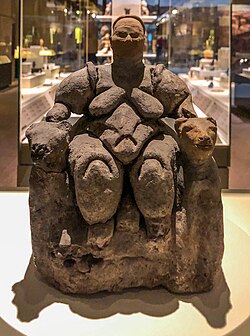
7400–6200 BCE Çatalhöyük · House, Wall Painting, and Figurine

At Çatalhöyük, wall paintings, reliefs, and figurines belonged largely to domestic life. It is therefore a strong case in which images lived not in a separate art space but within the house and everyday life. (UNESCO/Çatalhöyük)

Çatalhöyük wall painting interpreted as a map
Çatalhöyük wall painting interpreted as a “map” (link to discussion of Meece 2006)
Seated Woman of Çatalhöyük figurine
Çatalhöyük · Seated Woman figurine (Wikipedia/Seated Woman of Çatalhöyük)
Details

The famous wall painting interpreted as a plan of the settlement beneath an erupting Hasan Dağ raised the possibility of spatial representation. Yet its identification as a “map” is not certain; the same composition has also been read convincingly as a leopard skin above a geometric pattern. (Meece 2006)

Source ↗

4th–1st millennia BCE Mesopotamian Civilizations

Among the Sumerians, Babylonians, Akkadians, and Assyrians, image-making developed together with temple, palace, writing, and institutional representation. Votive statues, cylinder seals, and Assyrian palace reliefs belong to this wide repertoire. (The Met/Assyrian Relief)

Assyrian palace relief
Nimrud · relief from the palace of Ashurnasirpal II (The Met)
Details

It does not seem right to reduce Mesopotamian art to one-line generalizations such as “proportion was not important.” In Assyrian reliefs especially, image, inscription, and architectural space are clearly joined. (The Met)

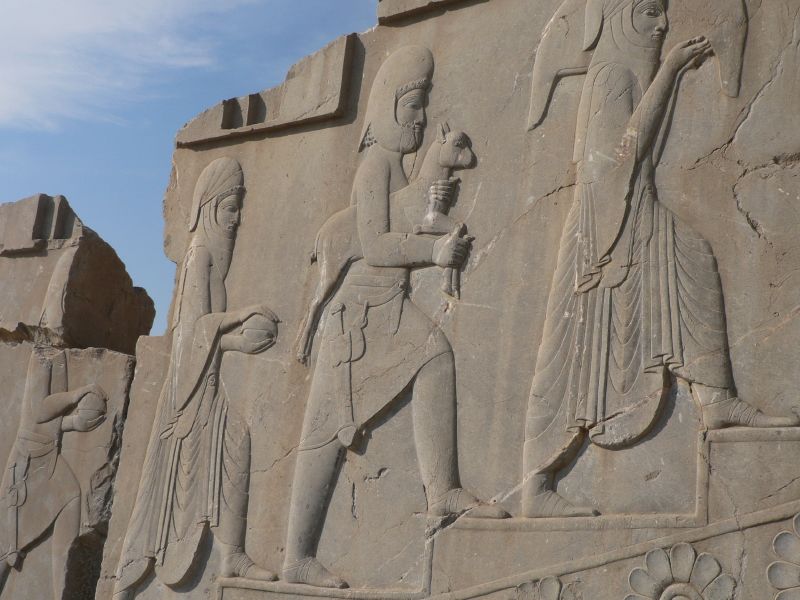
The processional reliefs of Persepolis (600 BC)belong to a later Achaemenid Persian context and may be read as another powerful example of institutional and ceremonial representation. These are not ziggurat reliefs but part of the stone relief program of the palace terrace. (The Met/Persia, Achaemenid)

Persepolis Apadana procession reliefs
Persepolis · processional reliefs on the Apadana stairway (Wikimedia Commons)

Source ↗

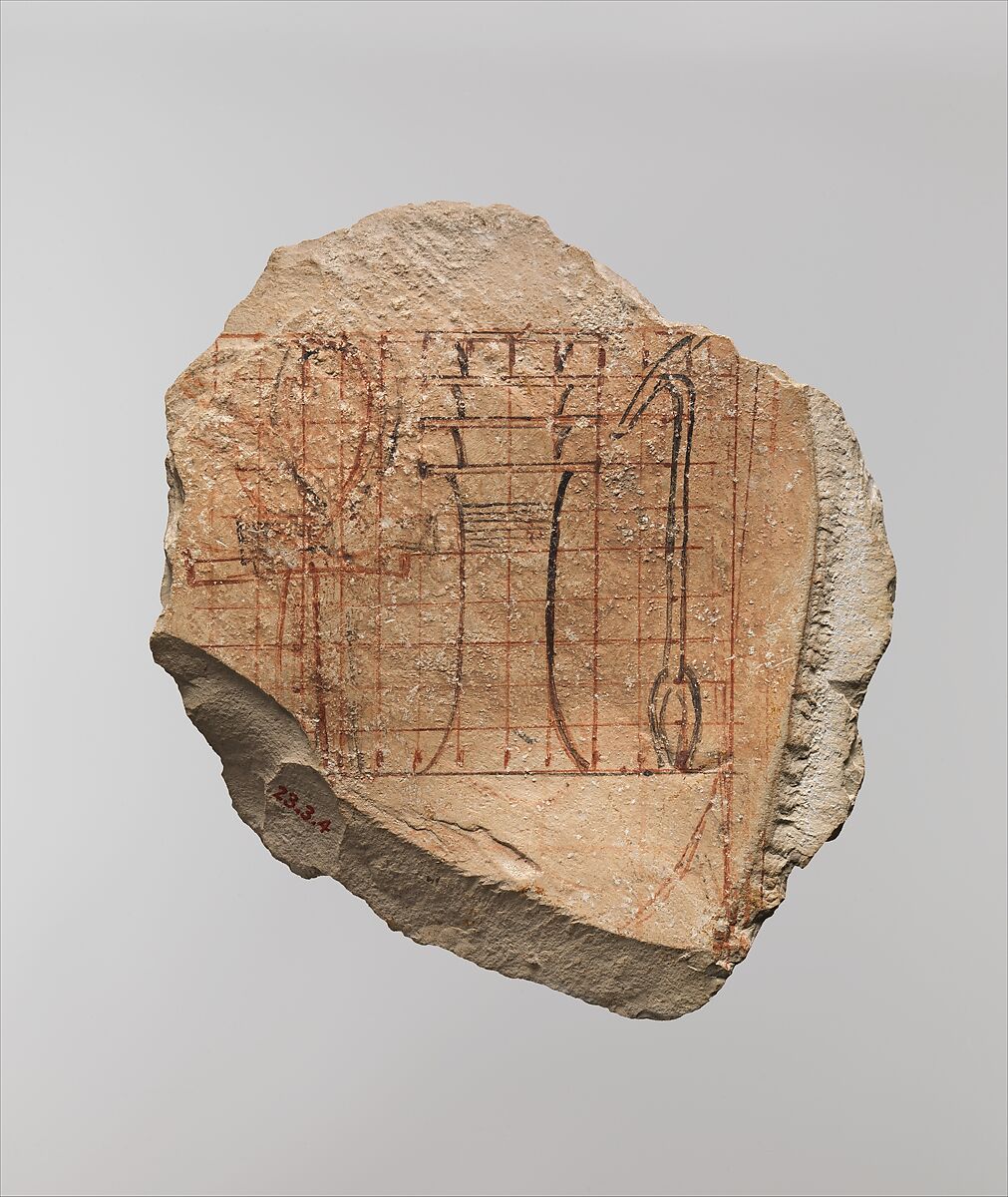
3rd–1st millennia BCE Ancient Egypt

In Ancient Egyptian painting and relief, figures are often organized in registers; proportion, scale, and placement operate as means of making social and cosmological order visible. (The Met 2000)


Artist's Scaled Drawing of Hieroglyphs
Details

Rather than reading this through a language of lack—“they did not know perspective”—it seems more meaningful to understand it as a different representational aim. (The Met 2000)

Source ↗

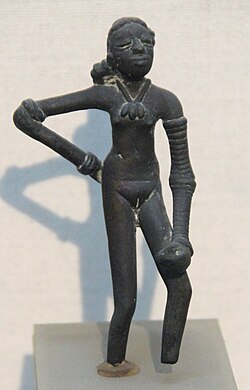
c. 2700–1900 BCE Indus-Harappa

Small bronze figures, seals, and ornaments from Harappa and Mohenjo-daro show visual production developing together with advanced craft and metallurgy. The bronze “Dancing Girl” from Mohenjo-daro is one of the best-known examples. (National Museum India/Harappan Civilization)

Indus Dancing Girl
Mohenjo-daro · “Dancing Girl” (Wikipedia/Dancing Girl)
Details

“Dancing Girl” is a modern label; the figure’s social meaning is not securely known. The same caution applies to seals. Even so, the meeting of bodily image, metallurgy, and the urban environment within the same material culture remains important. (National Museum India)

Source ↗

Shang–Zhou · 1600–221 BCE China · Ritual Bronzes and Music

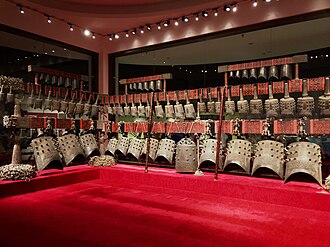
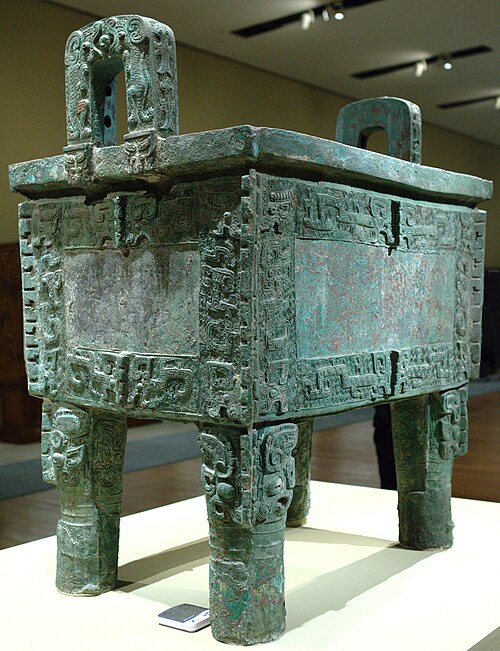
During the Shang and Zhou periods, bronze vessels and bells were tied to ritual, courtly order, metallurgy, and music. Some ancient Chinese bells could sound two distinct pitches; the bells of Marquis Yi are among the strongest examples of this tradition. (Smithsonian/NMAA)

Bells of Marquis Yi
Bells of Marquis Yi (Wikipedia/Bianzhong of Marquis Yi of Zeng)
Chinese ritual bronze
Ritual bronze vessel (Wikipedia/Ritual bronzes of ancient China)
Details

This example shows that the relation between music and ordering or mathematical thought is not a story belonging only to the Greek world. In ancient China, bronze casting, acoustic knowledge, ritual, and political representation could converge in the same group of objects. (The Met/Music and Art of China)

Source ↗

c. 900 BCE – 200 CE Africa · Nok Terracottas

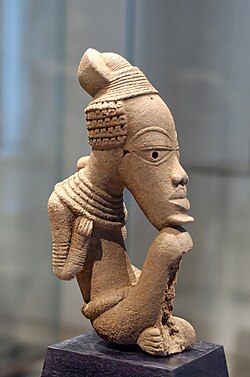
The Nok terracottas belong to one of the early traditions of figurative sculpture in sub-Saharan Africa. Most finds are fired-clay human or animal forms. (The Met/Nok Terracottas)

Nok terracotta head
Nok terracotta head (Wikipedia/Nok culture)
Details

African art history cannot be told through Egypt alone. At the same time, in the Nok case it remains difficult to state the function of the figures with certainty; most interpretations should be handled cautiously. (Blench 2024)

Source ↗

c. 1600–350 BCE Olmec · Monumental Representation and Public Space

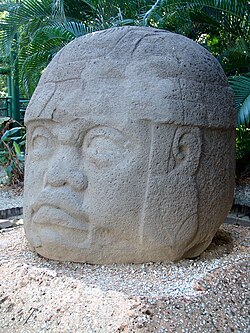
The colossal basalt heads of the Olmec world are strong examples of visual representation at public scale. Their individualized faces and headdresses suggest high-status persons. (Smarthistory/Olmec Colossal Heads)

Olmec colossal head
Olmec head (Wikipedia/Olmec colossal heads)
Details

The transport of basalt over long distances suggests that these sculptures matter not only formally but also in terms of organized labor. Art can here be read together with social status, public representation, and collective work. (The Met/La Venta Stone Sculpture)

Source ↗

6th–4th centuries BCE Greek Sculpture

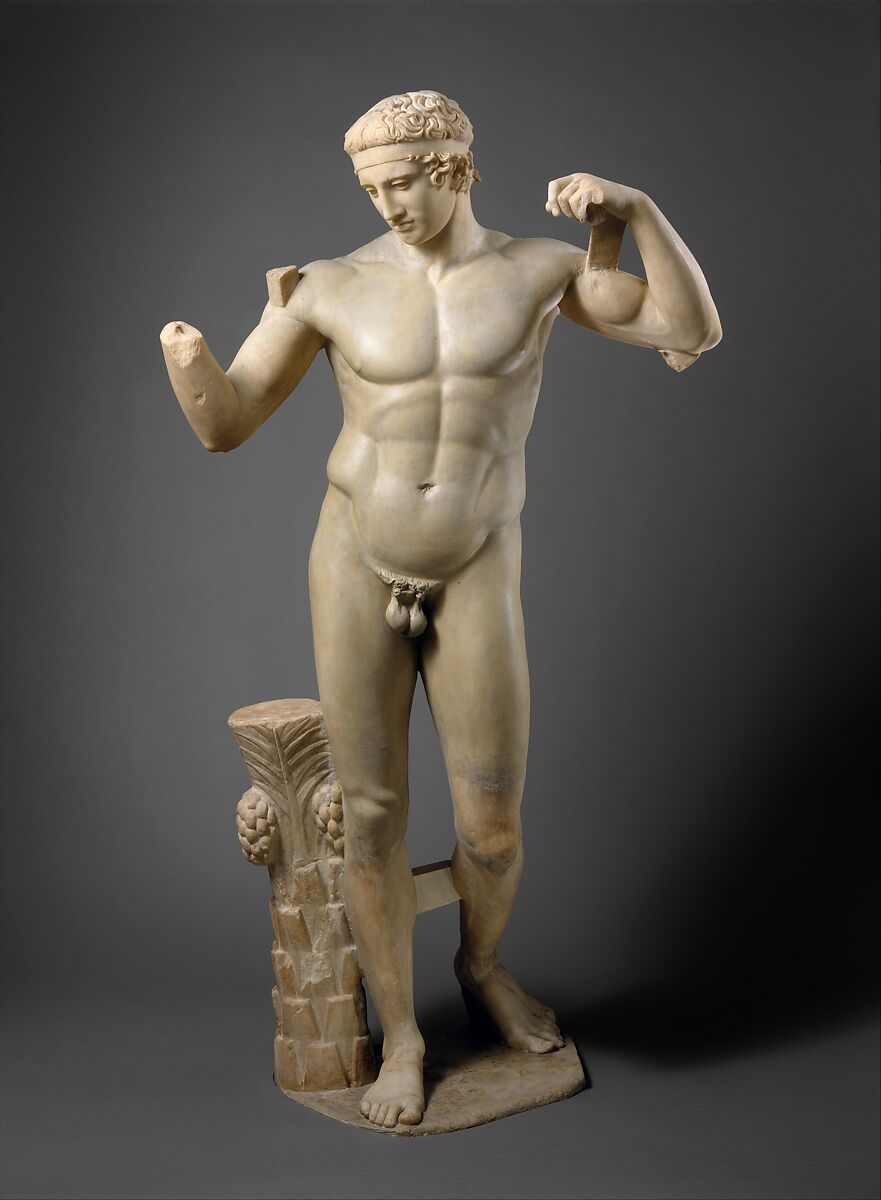
GREEK SCULPTURE investigated bodily proportion, stance, and the relation of parts to the whole in increasingly systematic ways, especially in the Classical period. Polykleitos’s lost Canon is one of the strongest examples of this search. (The Met/Polykleitos)


Diadoumenos (youth tying a fillet around his head
Details

A historical affinity can be drawn between Pythagorean thought about number and sculptural investigations of proportion, but it requires caution to turn this into a direct one-way causation. What seems safer is to note the growing search for measurable relations among number, ratio, music, geometry, body, and architecture in the same broad period. (The Met/Polykleitos)

Source ↗

5th century BCE and later Perspective in Ancient Greece

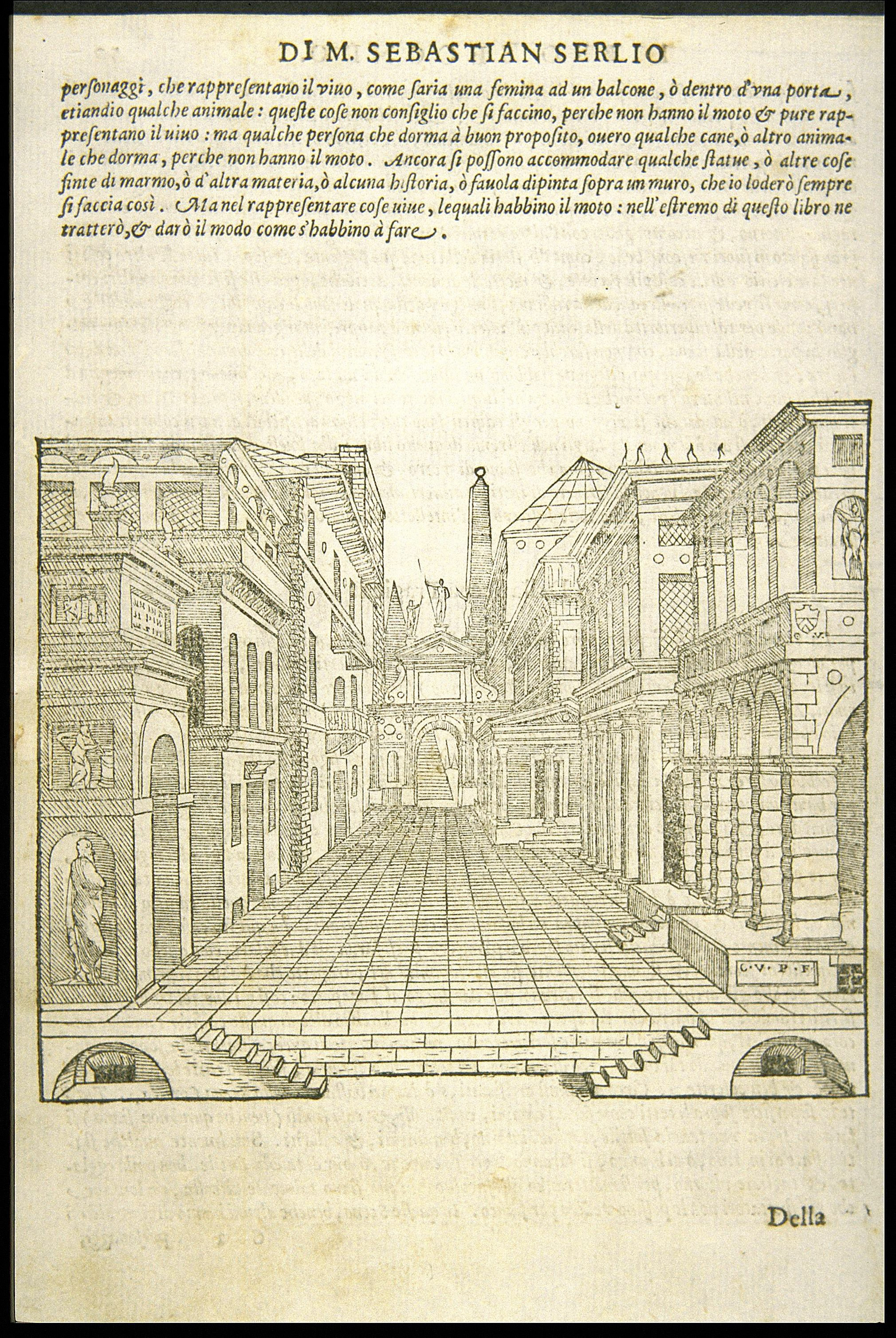
Hellenistic painters and scene designers could create illusions of depth, yet it does not seem right to identify this directly with the later Renaissance one-point system. Vitruvius gives evidence about Agatharchus’s stage painting and the writings of Democritus and Anaxagoras on viewpoint. (Vitruvius, Book VII) The rule of "lines converging on a fixed point of view"—theorized by Democritus and Anaxagoras—was redrawn in the 16th century by the architect Sebastiano Serlio, based on the text of Vitruvius.

redrawn in the 16th century by the architect Sebastiano Serlio, based on the text of Vitruvius.
Details

What seems significant here is that visible space itself becomes a measurable and modelable problem. (Vitruvius)

Source ↗

Ancient Greek · Ancient Greek Music Theory

The Ancient Greek term mousikē referred not only to music in the narrow modern sense, but to a broader field including song, poetry, and dance. Ancient Greek music theory then became a field for investigating the relation between the sensory experience of sound and number or ratio. (Pesic 2014) (Cambridge History of Musical Performance)

Details

This broad meaning shows that poetry, music, dance, and performance had not yet separated into autonomous institutions. Music appears here both as part of public or ritual experience and as a theoretical field in which number and sensation are tested against one another. (Cambridge History of Musical Performance)

Source ↗

c. 570–495 BCE Pythagoras

The tradition of PYTHAGORAS became one of the most influential carriers of the idea that consonant musical intervals correspond to simple whole-number ratios. The octave, fifth, and fourth became associated with the ratios 2:1, 3:2, and 4:3. (SEP/Pythagoras)

Details

The blacksmith-shop story is famous, but it appears in later sources and would not work physically as described. Even so, the fact that heard consonance becomes expressible as numerical relation seems to mark an important threshold between sensory experience and abstraction. (SEP/Pythagoras)

Source ↗

Ancient Greek Philosophy

In Ancient Greek natural philosophy, music became one of the fields in which the relation between number and the sensible world was investigated. The group of arithmetic, geometry, astronomy, and music increasingly came to be thought together in antiquity, although the name quadrivium belongs to a later period. (SEP/Archytas)

Details

It is therefore appropriate to place the relation of music, mathematics, and astronomy in Greek antiquity, while projecting the later medieval institutional name backward would be anachronistic. (Pesic 2014)

Source ↗

c. 470–390 BCE Philolaus

For PHILOLAUS, harmonia means not only musical consonance but also the fitting together of unlike things into an ordered whole. “To harmonize is literally to ‘octavize’.” (Pesic 2014) This is important for showing how musical intervals were considered together with cosmic and conceptual order.

Details

Philolaus is especially important for FDBM because he employs music, number, and cosmos within one explanatory order. Number here becomes not merely a tool of calculation but a way of grasping order in the world. (SEP/Philolaus)

Source ↗

5th–4th centuries BCE Archytas

ARCHYTAS left one of the earliest texts to treat astronomy, geometry, logistic/arithmetic, and music together. His investigation of musical intervals through mathematical relations shows music and mathematics meeting at the level of method. (SEP/Archytas)

“Archytas took Philolaus’s ideas as the basis of what he called the four mathēmata, literally ‘learnable things’: astronomy, geometry, ‘numbers’ (arithmetic), and music. These four are united because ‘their concern is with the two primary forms of what is, which are sisters themselves,’ by which Archytas may have meant the realms of the visible and the audible.” (P. Pesic 2014)

Details

His exact birth and death dates are not known; current assessments place him roughly in the fifth and fourth centuries BCE. The older date “428–247 BCE” therefore cannot be retained. (SEP/Archytas)

Source ↗

5th century BCE Agatharchus

The most important early testimony about AGATHARCHUS comes from Vitruvius. He reports that Agatharchus painted scenery for Aeschylus and that this prompted Democritus and Anaxagoras to think about visual rays and viewpoint. (Vitruvius, Book VII)

Details

Vitruvius’s account is not enough to make him the “inventor of modern perspective,” but it does show a debated relation among scene painting, architectural appearance, and the geometry of perception. (Vitruvius)

Source ↗

525–456 BCE Aeschylus

AESCHYLUS is one of the major authors in the formation of early Classical tragedy. In ancient theatre, text, chorus, music, dance, and staging converged within one public performance. (Vitruvius)

Details

Theatre matters here less as a private object than as a public event in which citizens gather together. For that reason Aeschylus is valuable here also for thinking about the relation between art and public space.

Source ↗

5th century BCE Polygnotus

POLYGNOTUS’s paintings Nekyia and The Capture of Troy at Delphi are known from ancient sources, but the originals do not survive. The images seen today are therefore modern reconstructions. (Wikipedia/Polygnotus)

Reconstruction of Polygnotus Nekyia
Polygnotus · modern reconstruction of Nekyia (Wikipedia/Polygnotus)
Details

Rather than judging Polygnotus by later technical standards, it may be more useful to think about the relation between painting, architectural interior, and public experience. (Delphi Archaeological Site)

Source ↗

4th century BCE Praxiteles

PRAXITELES was one of the most influential Greek sculptors of the fourth century BCE. The Aphrodite of Knidos stands out as an early and highly influential large-scale freestanding nude female deity. (Wikipedia/Praxiteles)

Tradition of the Aphrodite of Knidos
Tradition of the Aphrodite of Knidos (Wikipedia/Praxiteles)
Details

The original is lost; its form is known through ancient accounts, coins, and later copies. It is also important that the statue was meant to be experienced by moving around it in space. (The Met/Aphrodite of Knidos)

Source ↗

480–406 BCE Euripides

In the later tragedies of EURIPIDES, solo song (monody) becomes a dramatic means of shaping individual voice and a wider emotional range. (Catenaccio 2023)

Details

This development shows that the function of music in theatre was not limited to collective ritual order; it could also open toward individual voice and interior experience.

Source ↗

PHYSICS

Physics and Natural Philosophy

The word physics, derived from the Ancient Greek physis, meaning “nature,” became a more recent classification in the sense of today’s independent discipline; neither in the Ancient Greek world nor in the medieval Islamic world was there a separate discipline corresponding exactly to modern physics.

Even the celebrated physicist Isaac Newton (1642–1726) titled his major work Philosophiae Naturalis Principia Mathematica (Mathematical Principles of Natural Philosophy, 1687) and understood his work within natural philosophy rather than a modern, separate discipline of physics. In the Islamic world, subjects such as light and sound—which we now place within physics—were also often discussed together with the mathematical sciences.

Details

In this context, Ibn al-Haytham (965–1040), whose work in optics was highly significant, was for a long time regarded in both East and West more as a mathematician than as a physicist.

Physics is a broad field concerned with the properties, states and motions of bodies. As knowledge expanded through the Renaissance and afterward, investigations of nature became increasingly differentiated; areas such as mechanics, optics, acoustics and electricity became more distinct, while later interdisciplinary fields such as mathematical physics, astrophysics, geophysics and biophysics developed. Physics now encompasses many areas including mechanics, thermodynamics, gravitation, light, optics, acoustics, electricity, magnetism, atomic physics, wave mechanics, quantum theory and relativity. (Zeki Tez 2021, Fiziğin Kültürel Tarihi)

The Oxford Classical Dictionary notes that ancient physikē and related terms derive from physis, while the ancient field covered a much broader inquiry into nature than the modern discipline of physics. Oxford Physics likewise notes that what we now call physics was largely known as “natural philosophy” until the nineteenth century. The Newton Project confirms the 1687 title Philosophiae Naturalis Principia Mathematica. (Oxford Classical Dictionary/Physics) · (Oxford Physics/Natural Philosophy) · (Newton Project/Principia 1687)

Classifying Ibn al-Haytham simply as either a “mathematician” or a “physicist” may also project modern disciplinary boundaries backward. Roshdi Rashed emphasizes the way his work in optics, astronomy and statics reconnects mathematics with physical phenomena, while the TDV Encyclopaedia of Islam likewise stresses the combination of mathematical analysis with physical and experimental dimensions in his optics. (Rashed/Ibn al-Haytham) · (TDV/Ibn al-Haytham)

650–480 BCE Early Greece · Thales and Anaximander

A rational interpretation of nature became increasingly visible in early Greece with the Presocratic thinkers. Thales of Miletus looked for natural causes alongside religious and mythological explanations and treated water as the first principle of things.

Anaximander of Miletus, traditionally associated with Thales, instead proposed the apeiron—the boundless or indeterminate—as the underlying principle.

Details

The accounts of Thales treating water as a first principle and Anaximander proposing the apeiron reach us through Aristotle and later ancient sources. The SEP discusses them among the early thinkers who investigated the causes and principles of nature. (SEP/Presocratic Philosophy)

The teacher–student sequence Thales–Anaximander–Anaximenes belongs to the ancient tradition, but its historical certainty is limited. Calling Anaximander's account the “first theory of evolution” is also a modern label; it seems more cautious here to speak of an early natural account of generation and living beings. Reports about Thales, magnets and amber likewise come through later testimony, so calling them “experiments” in the modern sense requires caution. (SEP/Presocratic Philosophy)

580–525 BCE Anaximenes

Anaximenes, one of the last of the early Milesian natural philosophers, replaced Thales' fundamental substance of water with air and proposed a different model of the universe from Anaximander.

Anaximenes' universe is presented here as a seven-part connected order:

  1. undifferentiated elemental structure
  2. the realm of the stars
  3. the sphere through which the Sun travels
  4. the sphere of the Moon
  5. the arrangement of air that produces rain, thunder and snow
  6. seas and rivers
  7. the Earth, which nourishes everything and was thought to arise from water, whose source in turn was “compressed air”

Anaximenes' lasting contribution is associated less with the details of this cosmology than with the place he gave to condensation and rarefaction in the structure of the universe. The approach can be read as an early attempt to explain qualitative differences among substances through quantitative change.

Details

The SEP confirms that Anaximenes proposed air as the underlying substance and explained natural change through rarefaction and condensation: air becomes fire by rarefaction and wind, cloud, water, earth and stone through increasing condensation. (SEP/Presocratic Philosophy · Anaximenes)

The teacher–student sequence among the Milesian thinkers belongs to ancient tradition and should not be treated as a fully secure biographical chronology. The seven-part cosmological scheme is harder to verify in exactly this form in strong academic sources, so it seems more cautious to read it as an inherited presentation of the period's cosmology. (SEP/Presocratic Philosophy)

550–480 BCE Heraclitus of Ephesus

Heraclitus of Ephesus treated change as one of the fundamental features of nature. This idea was later widely summarized in the familiar saying, “No one steps into the same river twice.” Time and change remain among the fundamental concepts of modern physics.

Details

The SEP notes that the familiar formulation “No one steps into the same river twice” is not a securely preserved direct quotation from Heraclitus but a later way of summarizing his thought. The surviving fragments allow change to be read not merely as “everything flows,” but also through contrary states changing into one another and forming a system of connections. (SEP/Heraclitus)

When we extend the same question eastward, Chinese cosmological thought from the mid-fourth century BCE describes a world in which “all things are interconnected and constantly changing.” Later correlative cosmology likewise understands natural things and events not only through their isolated properties but through relations and transformations among them. This is not the same system as Heraclitus' thought; yet when we read the two together, a noteworthy similarity appears in treating change and relation as starting points for understanding nature. (SEP/Chinese Metaphysics)

David Wang later examines the architectural implications of this correlative view in A Philosophy of Chinese Architecture. We will return to the question of how such a view becomes visible in space and urban life in the Architecture section. For the broader comparison, see (Coşkun, Cities From Antiquity to the Present III) · (Wang 2017)

5th century BCE → India · Impermanence, Atom and Prakṛti

In the Buddha's teaching, emerging at roughly the same broad historical threshold as Heraclitus, impermanence and the conditioned arising of events take an important place rather than an unchanging underlying world. (SEP/Buddha)

Later Indian thought about nature developed different models side by side: some explained the world through combinations of atoms, while Sāṃkhya understood it through the continuous transformation of prakṛti. (SEP/Naturalism in Classical Indian Philosophy)

Details

It is important not to collapse different periods into one another. Impermanence (anicca) and conditioned arising are central to early Buddhist teaching, while the fully systematic doctrine that divides all physical and mental phenomena into discrete moments was developed by later Buddhist schools. The comparison between Heraclitus and the Buddha is therefore not a claim of a shared doctrine or direct influence, but an observation that questions of change, persistence and conditionality became strongly visible in two different intellectual worlds at roughly the same broad historical threshold. (SEP/Abhidharma)

Classical Indian philosophy contains no single “view of nature.” Atomist accounts developed in Nyāya–Vaiśeṣika and among some Buddhist and Jaina thinkers, while Sāṃkhya explained the world through the transformation of an ever-dynamic root-nature, prakṛti. Here again we can see how the same broad question—how matter and change are to be understood—can open different conceptual paths in different cultures. (SEP/Naturalism in Classical Indian Philosophy)

5th century BCE Leucippus

Leucippus is associated with the search for natural explanations of natural phenomena and is regarded, together with his student Democritus, as one of the foundational figures of ancient atomism.

Details

Very little secure information about Leucippus survives. The SEP notes that ancient sources often discuss Leucippus and Democritus together and that Aristotle attributes the founding of the atomist system to Leucippus. (SEP/Leucippus)

The older formulation that Leucippus “firmly opposed divine intervention in the universe” cannot be directly verified from a secure surviving fragment. The non-teleological natural explanation of atomism can be read in that direction, but it seems more cautious to emphasize the atomist search for natural causes than to assign a strongly worded personal position. (SEP/Leucippus)

460–370 BCE Democritus

Democritus, together with Leucippus, is one of the foundational figures in the development of atomism. In atomism, natural generation and change are explained through the motion, combination and separation of unchanging and indivisible atoms in the void.

Details

The SEP treats Democritus together with Leucippus as one of the two principal figures of ancient atomism. Atoms are indivisible and unchanging basic bodies, while observable change is explained through their arrangements and motions in the void. (SEP/Democritus)

Rather than compressing the mathematical and celestial observational traditions of Mesopotamia into a single general sentence in the Physics section, it seems more useful to follow them separately in the Astronomy section. This will allow the long Babylonian traditions of observation, recording and periodicity to be read in their own historical context. (Oxford Handbook of Science and Medicine in the Classical World)

BIOLOGY

10,000 years ago → Early Humans

Early humans must have passed from generation to generation the knowledge they possessed about plants and animals that was necessary for survival. This inherited knowledge probably included information about human and animal anatomy as well as animal behaviour such as periods of migration.

One important threshold in biological knowledge was the Neolithic transformation. Across this broad process, plant cultivation and animal domestication developed in different regions and at different times.

Ancient cultures such as Mesopotamia, Ancient Egypt, the Indian subcontinent and China later developed different traditions of knowledge about nature, the body and health, producing physicians and investigators such as Sushruta and Zhang Zhongjing. Ancient Greek natural philosophy is also treated as an important strand in histories of modern biology.

Details

Archaeological and genetic research shows that agriculture and domestication were not a single “revolution” occurring at one centre, but long, multi-centred processes that developed in different parts of the world. Current research identifies numerous independent centres of domestication in both the Old and New Worlds and shows that plant domestication developed in parallel across several regions. (PNAS/Current Perspectives on Domestication) · (PNAS/Plant Domestication)

It therefore seems more cautious to read the Neolithic transformation not as the single beginning of biological knowledge, but as one important threshold that permanently changed human relations with plants and animals. Settled life, production, storage and more continuous contact with animals must also have changed the scope of everyday knowledge about living things.

3000 BCE → Indian Medical Tradition · Ayurveda

The early history of Indian medicine can be traced back to the protohistoric Harappan culture of the Indus Valley Civilization. The cities of Harappa and Mohenjo-daro show developed arrangements for water, drainage and hygiene. Vedic texts, especially the Rig Veda, contain early references to illness, plants and herbal remedies.

Ayurvedic medicine gives importance to preventing disease, preserving health and treatment.

Details

M. R. Raghava Varier traces the study of Indian healing and healthcare traditions back to protohistoric Harappan culture and notes that information about medicine, treatment and physicians becomes more detailed across different layers of Vedic literature. (Varier 2020, A Brief History of Āyurveda)

The urban arrangements of Harappa and Mohenjo-daro are important evidence for early practices of hygiene and public health; however, it seems more appropriate to read them as part of the broader early history of Indian health knowledge rather than as direct evidence of a fully systematized Ayurveda. Ayurveda's codified theoretical structure becomes clearer in the later samhita tradition. Here we can therefore follow both everyday and urban health practices and the gradual systematization of knowledge about body and treatment. (Oxford Academic/A Brief History of Āyurveda)

5th century BCE Alcmaeon

Alcmaeon of Croton is counted among the Presocratic thinkers and worked on questions of anatomy, medicine and physiology. He proposed that the brain was central to understanding and human perception and thought that the sensory organs were connected with the brain through channels.

Within this approach, illness is related to natural processes within the body rather than supernatural causes, and health is described as being maintained by a balance among opposing powers, while disturbance of that balance produces disease. (SEP/Alcmaeon)

Details

Alcmaeon's exact date is uncertain; he probably wrote his work sometime between 500 and 450 BCE. His relation to Pythagoreanism is also disputed, so it seems safer to treat him as an independent medical and natural investigator working in Croton rather than as a leader of the Pythagorean school. (SEP/Alcmaeon)

Ancient testimony suggests that he may have observed channels extending from the eye toward the brain; however, there is no secure evidence that he used systematic dissection or distinguished veins from arteries. The SEP more strongly supports his view that the brain was the centre of understanding and that the senses were connected to it through channels. He also developed accounts of sight, hearing, taste and smell; hearing, for example, was explained through the transmission of external sound by the empty space within the ear toward the brain. (SEP/Alcmaeon)

His ideas about reproduction and embryonic development are known from later testimonia. Views concerning contributions from both parents, the relation of seed to the brain, and the head as the first part of the embryo to form were attributed to him, although the sources do not fully agree on these details. Alcmaeon's acknowledgement that certainty may not be possible in some unseen processes also suggests an early awareness of the limits of such biological inquiry. (SEP/Alcmaeon · Embryology)

One of the most striking formulations attributed to him describes health as the equality of opposing powers—such as hot and cold, dry and wet, bitter and sweet—while the dominance of one produces disease. Reading bodily order through such a relational balance seems to form an interesting threshold when placed beside other attempts of the period to understand nature and social order through relations. (SEP/Alcmaeon · Health and Disease)

460–370 BCE Hippocrates

Hippocrates of Kos is remembered in the history of medicine as the “father of medicine.” In Plato's Phaedrus, Hippocrates is invoked in connection with the idea that understanding the nature of the body cannot be separated from considering the nature of “the whole.”

The Hippocratic Corpus consists of medical writings, most of them composed by different authors in the fifth and fourth centuries BCE. Within this tradition, natural causes of illness, observation, diet and prognosis occupy important places, and the corpus remained influential in Arabic and European medical traditions. (Oxford Classical Dictionary/Medicine)

Details

The Oxford Classical Dictionary dates most of the roughly sixty medical writings loosely known as the Hippocratic Corpus to 450–350 BCE. Because these texts were written by different authors and their relation to Hippocrates has been debated since antiquity, the corpus should not be read as a single work written by one person. (Oxford Classical Dictionary/Medicine)

The Latin phrase Primum non nocere (“First, do no harm”), widely associated with Hippocrates, does not appear in that form in the Hippocratic Oath. The older Hippocratic tradition in Epidemics, however, does contain the idea that the physician should aim to benefit the patient or at least not cause harm. (BMJ/Primum non nocere)

The meaning of “the whole” invoked through Hippocrates at Plato's Phaedrus 270c is also debated in modern scholarship: interpretations have included the environment, the cosmos and the individual body. The tendency to understand the body within wider relations is therefore genuinely visible in the passage, but it seems more appropriate to leave this as an open research question than to turn it into one fixed “holistic medical theory.” (Jelinek & Pappas 2020)

Some details transmitted through Menon concerning nutrition and disease also belong to later testimonia about Hippocrates; given the multi-authored nature of the corpus, caution is needed before treating them as one unified “Hippocratic theory.” By contrast, an early clinical description of digital clubbing is strongly associated with the Hippocratic tradition and remains known as “Hippocratic fingers.” (NCBI/Clubbing)

3rd–1st century BCE → China · Relational Medicine between Body and Nature

Within the same broad historical process, Chinese medical thought understood the body through relational patterns such as yin–yang, qi and the Five Agents. In the Huangdi Neijing tradition, health and illness were understood through relations within the body as well as through correspondences between body, nature and cosmos.

We will later return to how this relational view became inhabitable through space and architecture. (SEP/Science and Chinese Philosophy)

Details

Early Chinese medical and cosmological thought used qi, yin–yang and the Five Agents within a shared intellectual context and developed correspondences among body, state and cosmos. The SEP notes that the Huangdi Neijing brought these ideas together within a systematic medical cosmology and used them in models of the body as a microcosm. The text in its surviving form is multi-layered, and its core was probably compiled around the first century BCE. (SEP/Science and Chinese Philosophy)

The relational or correlative view of nature encountered in the Physics section becomes visible here again in relation to body and medicine: the body is not treated simply as an isolated object, but within relations involving seasons, environment, celestial order and a wider cosmological pattern. Physics · Heraclitus and the China comparison

Although the modern word “holistic” can describe some aspects of this approach, reading the historical structure as relational or correlative seems more precise. This also opens a path toward asking how body–nature relations in Chinese medicine may later speak to the relational understanding of space that we will follow through Wang and Chang in architecture. (SEP/Chinese Philosophy and Chinese Medicine)

ARCHITECTURE

9000–3500 BCE Seasonal Gathering, Settlement, and Architecture as a Keeper of Time

The transition to settled life did not happen at a single date. In different regions, hunter-gatherer meeting and ritual places, villages, and later agricultural settlements emerged at different times. Early centres as different as Nabta Playa, Göbekli Tepe, and Stonehenge show that architecture could do more than provide shelter: it could organize gathering, shared time, and repeated practices in space. (A Global History of Architecture)

Details

Rather than reading these examples as successive stages of one developmental line, it seems more useful to compare how natural cycles and collective practices acquired spatial forms in different regions. Shared architectural foci could bring communities together before permanent state institutions existed. The open question is how early architecture began to make cyclical natural time collectively experienceable and memorable. (City III) (A Global History of Architecture)

9600–8200 BCE Göbekli Tepe: Gathering, Ritual, and Monumental Architecture

At Göbekli Tepe, hunter-gatherer communities built monumental stone structures between about 9600 and 8200 BCE. With their large T-shaped pillars, these structures show that before city-states emerged architecture could already create a place for collective labour, gathering, and ritual beyond shelter. (A Global History of Architecture)

Göbekli Tepe monumental stone pillars
Göbekli Tepe · image source ↗
Details

From Antiquity to the Present: City III examines Göbekli Tepe as a possible threshold at which sharing, collective labour, and ritual could create an early public realm extending beyond the individual or household. Its relations with topography, stone, animal imagery, and seasonal practices suggest that architecture here may be read less as an object separated from nature than as an environment lived together with it. (Cities From Antiquity to the Present III) (A Global History of Architecture)

7400–6200 BCE Çatalhöyük: House, Memory, and a Streetless Settlement

At Çatalhöyük, mud-brick houses formed dense streetless clusters, with access largely from the roofs. Everyday life, production, burial, painting, and ritual were intertwined within the same settlement fabric. The house can therefore be seen not only as shelter but also as a place where everyday practices and communal memory acquired continuity. (UNESCO/Çatalhöyük) (A Global History of Architecture)

Çatalhöyük plan/görseli
Çatalhöyük · FDBM4 görseli · görselin kaynak sayfası ↗
Details

The repeated rebuilding of houses over generations, burials beneath domestic platforms, and dense symbolic deposits in some buildings support reading the house as a carrier of memory, while terms such as “tomb” or “history-writing” should remain interpretive. The linked Making Maps source also shows that the famous interpretation of a Çatalhöyük wall painting as a “map” remains disputed. (Making Maps) (UNESCO/Çatalhöyük)

6th–5th millennium BCE Early Chinese Settlements: Walls, Ditches, and Banpo

Neolithic Chinese settlements such as Banpo include houses, settlement boundaries defined by ditches, and larger buildings for shared use. In the history of Chinese architecture, enclosure and the wall appear very early as prominent elements of settlement order. (Steinhardt 2019)

Banpo yerleşim planı
Banpo yerleşim planı · görsel kaynak ↗
Banpo
Banpo · görsel kaynak ↗
Details

Early buildings made of perishable materials are often harder to recover archaeologically than enclosure works and rammed-earth walls. Banpo’s “Large House” is therefore more safely read as an early example of a larger communal building than as the direct beginning of later palace architecture. (Steinhardt 2019)

5000–3000 BCE Settlement, Irrigation, Storage, and Centralization

In Mesopotamian settlements such as Tell es-Sawwan, Eridu, and Uruk, mud-brick construction, irrigation, storage, craft production, and increasingly large communal or ceremonial buildings came together within the same settlement environments. By the time of Uruk, the scale of settlement, systems of production and storage, and practices of record keeping and administration had expanded markedly. (A Global History of Architecture)

Details

Uruk’s fourth-millennium BCE growth is closely associated with differentiated production and techniques for storing and processing information. (Cambridge World History)

Whether storage, record keeping, and redistribution added a “time of calculation” to cyclical natural time is a question pursued separately in City III; here it remains an open research line rather than a conclusion. (City III) (A Global History of Architecture)

4th–3rd millennium BCE Urban Threshold: Different Paths in Different Regions

During the fourth and third millennia BCE, population, production, administration, and building density intensified in several regions, especially Mesopotamia and the Nile Valley, producing new forms of urban organization. Urbanization in the Indus Valley and China developed within their own chronologies. The city can therefore be seen less as one uniform model invented in a single place and diffused outward than as a form of life emerging through different relations in different regions. (A Global History of Architecture)

Details

The significance of this threshold is not a single date for the “first city,” but the growing extent to which everyday life became organized through storage, movement, shared infrastructure, administration, and larger collective building. These processes did not follow the same sequence everywhere. (A Global History of Architecture)

3000–2500 BCE Stonehenge: Solstice, Gathering, and Commemoration

The first enclosure at Stonehenge dates to around 3000 BCE, while major phases of the stone settings belong around 2500 BCE. The relation of its principal axis to the solstices makes celestial and seasonal time visible through architectural orientation. Together with its wider burial and gathering landscape, Stonehenge became a long-lived focus in which time, commemoration, and shared ritual were experienced through architecture. (A Global History of Architecture)

Stonehenge megalithic stone setting
Stonehenge · image source ↗
Details

Neolithic and Bronze Age architecture in Europe does not form a single cultural trajectory; in different regions, megalithic tombs, ceremonial places, and seasonal or communal gathering sites became important at different times. Stonehenge is not the only example of this wider context, but it is a particularly strong one for reading shared time and gathering through architectural orientation. (A Global History of Architecture)

3000–1500 BCE Orientation, Timber Construction, and Early Urban Order in China

In Neolithic and Bronze Age China, north–south orientation, enclosure, rammed-earth foundations, and square-plan timber construction developed into a long-lived architectural order. Centres such as Erlitou show palace compounds, roads, and oriented settlement layouts. (Steinhardt 2019)

Details

The identification of Erlitou with the historical Xia dynasty remains debated. The emphasis here is therefore on directly observable architectural features—orientation, roads, rammed earth, and timber construction—rather than treating historical tradition and archaeological evidence as equivalent. It seems safer to read this development not as a single moment of origin, but as a long process of standardization and centralization. (Steinhardt 2019)

2600–1900 BCE Indus Cities and Mohenjo-daro

At Mohenjo-daro, fired-brick construction, the street network, wells, and an advanced drainage system were organized together at the scale of the city. The spread of housing, water, and waste infrastructure through the settlement is an early and powerful example of shared measures and technical knowledge becoming part of the urban organization of everyday life. (A Global History of Architecture)

İndus Vadisi uygarlığı haritası
İndus Vadisi uygarlığı · görsel kaynak ↗
Mohenjo-daro
Mohenjo-daro · görsel kaynak ↗
Details

UNESCO emphasizes the orthogonal street pattern of the lower town and the integral role of sanitation and drainage within the city plan. (UNESCO/Mohenjo-daro)

Read together with standardized weights, length measures, and brick ratios in the same region, this suggests that shared measurement could operate in urban infrastructure as well as production. (A Global History of Architecture)

c. 2000–1450 BCE Knossos: Court, Storage, Production, and Palace

The palace complex at Knossos brings storerooms, workshops, ceremonial spaces, and circulation systems together around a central court. (A Global History of Architecture) particularly emphasizes the strong presence of workshops in Minoan palatial organization. The palace can therefore be seen not only as a representational structure but as a multifunctional centre in which production, storage, ritual, and social encounter were spatially organized together.

Knossos palace complex
Knossos · (Wikipedia/Knossos) ↗
Details

The conjunction of storage, workshops, archives, ritual, and representative functions within the same complex is well documented archaeologically. (UNESCO/Minoan Palatial Centres) (A Global History of Architecture)

2nd millennium BCE Hattusha: Topography, Asymmetry, and Urban Organization

The walls, gates, temples, and royal structures of Hattusha were organized within a sloping and rocky topography. Rather than being forced into a single geometric scheme, the city developed together with terrain, terracing, circulation, and building groups. (A Global History of Architecture); (UNESCO/Hattusha)

Details

Ekrem Akurgal compares the asymmetrical, terrain-responsive order of Hittite architecture with later Aegean/Hellenic spatial arrangements. Rather than describing the Great Temple simply as a building that “does not follow geometric principles,” it seems more useful to examine the relations among terrain, terracing, circulation, and building groups. (Ekrem Akurgal, Anadolu Kültür Tarihi) (A Global History of Architecture)

1800–1200 BCE and later Mesoamerica and the Andes: Celestial Time and Ritual Gathering

In some early public complexes in the Andes, circulation, approach, and gathering were architecturally organized; in parts of early Mesoamerica, buildings formed axes related to the changing annual positions of the Sun. These examples show different ways in which seasonal and celestial knowledge could be lived spatially through ritual and collective gathering. (Vega-Centeno Sara-Lafosse 2017); (Milbrath 2017)

Huaca A Planı
Huaca A · Pampa de las Llamas–Moxeke · görsel/kaynak ↗
Details

These examples are better treated not as continuations of Mesopotamian state formation but as independent cases in which public order could be organized through natural rhythms and ritual participation. E-Group arrangements should not all be assumed to have served one fixed “observatory” function; their uses could change over time. (Vega-Centeno Sara-Lafosse 2017)

1600–1100 BCE Mycenaean Palaces: Craft, Storage, and Administration

Mycenaean palaces were not only structures of representation; craftspeople and workshops associated with ceramics, metals, stone, ivory, and textiles were part of social life. The organization of storage, production, record keeping, and administration around the same centre shows the palace becoming a spatial system that organized everyday social life. (A Global History of Architecture); (American Journal of Archaeology)

Details

The megaron plan is retained here as a typological reference illustrating the central-hall organization of Mycenaean palatial architecture. (American Journal of Archaeology)

Megaron plan
Megaron · image source ↗
1300–1046 BCE Yin Xu, Shang Capital: Palace, Ancestors, and Production

At Yin Xu, palaces, ancestral sacred areas, production zones, and timber buildings raised on rammed-earth platforms formed parts of the same capital-city order. Political administration, ancestral ritual, and production, though spatially differentiated, were organized within the same urban centre. (A Global History of Architecture); (UNESCO/Yin Xu)

Shang saray/ritüel mimarlığı
Geç Shang mimarlığı · görsel kaynak ↗
Shang sarayı
Shang saray mimarlığı · kitap/kaynak ↗
Details

Oracle-bone practice, ancestral ritual, palace/ancestral compounds, and production areas show political, ritual, and productive organization intersecting within the same capital. Rather than reducing this relation to a single formula of “theocracy,” it is more useful to follow the spatial proximity of different functions. (A Global History of Architecture)

from the 1st millennium BCE China: Modular Timber Architecture and Building Hierarchy

In Chinese architecture, timber framing developed into a long-lived building tradition based on measure and module. Palace, temple, and house could share the same basic structural system, while axis, courtyard, gate, roof, and ornament made the building’s social and ceremonial position spatially legible. (Steinhardt 2019)

Standard Chinese timber structure
Standard Chinese timber structure · FDBM4 archive image · source ↗
Details

Nancy Shatzman Steinhardt highlights a long-lived set of features in Chinese timber architecture: horizontal axes and low profiles; human scale; enclosed courtyards; a focal building within the complex; gates separating spatial realms; modular dimensions; hierarchy made legible through roof form and detail; and graded zones of privacy. Relations among mountain, water, and the siting of important buildings are also significant. (Steinhardt 2019)

Explicit written standards such as the later Yingzao Fashi belong to a much later period; early modular practice and later codification are not treated as the same thing here.

10th c. BCE (textual tradition) Solomon’s Temple: Architecture Transmitted in Writing

The dimensions, materials, spaces, and fittings of Solomon’s Temple are described in detail in the textual tradition. What is notable for architectural history is that a building could be transmitted not only through construction but also through measured and written description. (A Global History of Architecture)

Reconstruction of Solomon’s Temple
Solomon’s Temple · FDBM4 archive image · source ↗
Details

1 Kings 6–7 provides a detailed description of plan, dimensions, materials, and fittings. Tradition places the building in the tenth century BCE; because the temple itself cannot be archaeologically excavated, exact construction dates and its historical form are not independently established in full. No global priority claim such as “the first architectural work described in writing” is therefore made here. (A Global History of Architecture)

8th–5th c. BCE Iron: Tools, Production, and Change in the Built Environment

During the first millennium BCE, the expanding use of iron in weapons, agricultural tools, and building work brought significant changes in productive and construction capacity. This technical transformation occurred at different times in different regions and changed the tools of rural and urban life. (A Global History of Architecture)

Details

Current archaeometallurgy does not support a simple linear story in which iron metallurgy spread from one centre—especially “from the Hittites to the whole world.” Production techniques and scales of use developed at different times in different regions. (Archaeometry 2025) (A Global History of Architecture)

7th c. BCE Ashurbanipal’s Library: Collecting Knowledge in Space

Tens of thousands of cuneiform tablets and fragments gathered around Ashurbanipal’s palace at Nineveh show that knowledge was not only produced; it could be selected, stored, and transformed into institutional memory in a centre. (British Museum)

Details

Current British Museum research stresses that the tablets now called “Ashurbanipal’s Library” did not form one simple collection. Rather than assigning fixed percentages to categories of texts, it is safer to focus on the gathering and preservation of different texts in the palace context. (British Museum)

Eastern Zhou / Warring States Kao Gong Ji: Craft, Measure, and the Ideal Capital

The Kao Gong Ji treats craft production, materials, measurement, and construction knowledge within the same technical tradition; its description of an ideal capital arranges roads, gates, palace, market, and other urban elements in a prescribed order. It thus shows knowledge of measure and standards extending from the scale of craft to the scale of the city. (J-STAGE/Ancient Chinese capital models)

Chengzhou / Wangcheng planning diagram
Chengzhou / Wangcheng ideal-city diagram · source ↗
Plan of Chengzhou
Chengzhou plan · (A Global History of Architecture) ↗
Details

The brief and sometimes contradictory prescriptions do not support one definitive Wangcheng plan, nor is a global priority claim such as “the world’s oldest technological standards book” made here. Even so, the text is remarkable for bringing production standards, metrology, and urban order into the same technical tradition. (J-STAGE/Ancient Chinese capital models)

4th c. BCE Zhaoyu tu: Measured and Pre-drawn Architecture

The fourth-century BCE bronze Zhaoyu tu, excavated from the tomb of King Cuo of Zhongshan, shows buildings, their dimensions, and the distances between them on a measured plan. Architectural knowledge appears here not only as craft exercised during construction but also as an order drawn and dimensioned before building. (Cambridge University Press)

Zhaoyu tu bronze mausoleum plan
Zhaoyu tu · bronze mausoleum plan · source ↗
Details

King Cuo was buried around 310 BCE; the plan is therefore placed in the fourth century BCE rather than at 250 BCE. The Cambridge study describes the Zhaoyu tu as the earliest surviving architectural plan in China. (Cambridge University Press)

1st c. BCE–1st millennium CE India: Vāstuśāstra — Measure, Orientation, and Settlement

Vāstuśāstra is not a single book but a broad textual and practical tradition concerning houses, temples, settlements, measurement, ground preparation, orientation, and spatial geometry, formed across different periods. Within this tradition, building, settlement, nature, and cosmic order are related within the same spatial framework rather than treated as wholly separate topics. (Vāstu in Kauṭilya’s Arthaśāstra)

Mānasāra settlement plans
Mānasāra · settlement plans · image source ↗
Details

Early datable works such as the Arthaśāstra contain technical provisions concerning towns, houses, embankments, roads, and public order, while many fuller Vāstu/Śilpa texts took shape during the first millennium CE. A direct unbroken transmission from Indus cities to later Sanskrit Vāstu texts has not been demonstrated; it is safer to say that relations among measure, orientation, settlement, and cosmology were repeatedly reworked in South Asia across different periods. (Vāstu in Kauṭilya’s Arthaśāstra)

Feng Shui and Vāstuśāstra: Building, Nature, and Cosmic Order

Feng Shui and Vāstuśāstra are distinct historical and cultural traditions. Both, however, establish relations among site, orientation, topography, water, measurement, and cosmic order. En-yu Huang interprets such orientation prescriptions as attempts to connect built space with cosmic structure. (En-yu Huang)

Details

En-yu Huang compares orientation prescriptions in Feng Shui and Vāstuśāstra as attempts to connect built space with cosmic structure, including repeated relations to an axis mundi and the effort to make human dwelling stable within both the physical environment and a mental/cosmic model. (En-yu Huang)

This comparison does not imply that the two traditions share a single origin; it is limited to the relations that site and orientation establish between physical environment and cosmic model.