FDBM

Architecture Despite The Stream

Philosophy-Indexed History of Science and Architecture

UNDER DEVELOPMENT Portal content and features are still being developed.
I · Natural Phase II · Perception Phase III · Understanding Phase IV · Desire Phase V · Reason Phase VI · Spirit (Geist) Phase
UNDER DEVELOPMENT Portal content and features are still being developed.
100%
100% Disciplines

PHILOSOPHY

16th–18th c. EARLY MODERN PERIOD AND TOWARD THE ENLIGHTENMENT

In the early modern period, the problem of knowledge increasingly came to be framed in new terms. As objectivity became an important requirement, philosophers asked whether sensation alone was sufficient, to what extent knowledge arose from experience, and whether the human mind contained any innate knowledge.

The Enlightenment should not be treated as synonymous with the whole early modern period. It is better understood as an intellectual movement, especially from the late seventeenth through the eighteenth century, in which reason, experience, criticism and confidence in human judgement became increasingly prominent.

Details

Earlier formulation: “The Modern Age (also called the Age of Enlightenment), from the sixteenth century CE to the present.”

Previous source: Wikipedia · Age of Enlightenment ↗

Check / correction: The early modern period and the Enlightenment are not identical historical concepts. The Enlightenment is one of the major intellectual movements that emerged within the early modern period, especially from the late seventeenth through the eighteenth century. The main text has therefore been revised without conflating the two periods. Stanford Encyclopedia of Philosophy · Enlightenment ↗

17th–18th c. EMPIRICISM

Empiricism is the philosophical orientation that gives a determining role to experience and sensation in the formation of knowledge. In the early modern period it developed in strong debate with rationalism, which gave greater weight to reason and innate principles.

Although ancient philosophy included approaches that may be described as sensory or empirical, empiricism became a systematic philosophical orientation especially in the early modern period. Locke, Berkeley and Hume became its best-known British representatives and profoundly shaped later discussions of knowledge.

Details

Earlier formulation: Empiricism was described as holding that “the sole source of human knowledge is experience or sensation” and as the complete opposite of rationalism; the mind was also directly identified with a “blank slate”.

Previous source: Wikipedia · Empiricism ↗

Check / correction: The empiricism–rationalism distinction remains useful for understanding early modern philosophy, but presenting the two traditions as entirely isolated blocks would be too sharp. “Tabula rasa” should also be situated specifically within Locke's criticism of innate ideas; Locke's mind is not devoid of active capacities. The main text has therefore been made more general and cautious.

1463–1494 PICO DELLA MIRANDOLA

Pico della Mirandola has often been read as an important Renaissance humanist who emphasised the human being's place in the cosmos and the capacity for self-formation.

In this sense he may be seen as an early threshold in the transformation from medieval conceptions of humanity toward the problem of the modern subject that would become more explicit in Descartes. Yet Pico's ultimate orientation should not be reduced to secular individual autonomy; philosophical and mystical ascent remained central to his project.

Details

Earlier record: Mirandola's name appeared in the list, but the reason for keeping him in the Reason Phase philosophy sequence was not explained.

Research note: The well-known humanist reading of Pico's account of the human capacity for self-formation makes it possible to see him as a meaningful threshold between medieval conceptions of humanity and the later modern problem of the subject. However, treating him directly as a founder of modern secular individualism would be anachronistic. Stanford Encyclopedia of Philosophy · Giovanni Pico della Mirandola ↗

Why he is included here: He makes visible the Renaissance-humanist threshold preceding the Descartes–subject–modernity sequence in FDBM.

1596–1650 DESCARTES — METHODIC DOUBT AND THE SUBJECT

With Descartes, mathematical reasoning and methodic doubt became part of a new epistemological framework that questioned the reliability of the senses and sought certainty in clear and distinct rational apprehension. Sensory observation continued to play a role in the investigation of nature, but for Descartes the model of certainty was mathematical and rational.

Descartes is often described as one of the founders of modern philosophy. The methodic doubt developed in the Meditations on First Philosophy may be read as shifting the question from “what is true?” toward “of what can I be certain?”, making the reasoning subject a central point of modern philosophical inquiry.

Yet within Descartes's own system God continued to play an important role in grounding the reliability of clear and distinct perceptions.

Anthropocentric transformation: The human being increasingly came to be conceived as a subject, an agent and a bearer of autonomous reason. As Christian revelation and church doctrine weakened as the sole authorities of knowledge, judging through one's own reason became one of the defining features of modernity. Martin Heidegger likewise treated the conception of subjectivity that becomes explicit in Descartes as a decisive threshold for later modern understandings of the human being.

— Could the strengthening of the “subject” be read, where urbanisation erodes self-sufficiency, as an attempt by the individual to reconstruct the sense that “I can change myself”? A.Ç.G. Kent III, pp. 29–31/42 ↗

Details

Earlier formulation: Descartes was said to move knowledge toward accepting “findings obtained through sensation by means of mathematical proofs”, and to transfer the authoritative guarantor of truth from God to humanity.

Previous source: Wikipedia · René Descartes ↗

Check / correction: Descartes is not an empiricist who validates sensory findings through mathematical proof. Methodic doubt also calls the senses into question, while rational and mathematical apprehension provides the model of certainty. The interpretation concerning the strengthening of the modern subject has been preserved, but God retains an epistemic guaranteeing role within Descartes's own system. Stanford Encyclopedia of Philosophy · René Descartes ↗

Heidegger note: The earlier claim that Descartes provided the foundation for “all later anthropology” was too broad. The main text has been narrowed to the claim that Cartesian subjectivity became a decisive threshold for modern conceptions of the human being.

1632–1677 SPINOZA

Spinoza, unlike Descartes's treatment of mind and body as distinct substances, understood mind and body as two expressions of the same reality under the attributes of thought and extension. Rather than a hierarchy between mental and bodily processes, his account is commonly described in terms of correspondence or parallelism.

Spinoza also rejected explanations of nature in terms of final causes and treated nature through necessary causal relations.

Details

Earlier formulation: “Instead of the superiority of body or soul over one another, Spinoza defended their parallelism and also opposed teleological causation.”

Correction: The central point has been preserved. The wording has been clarified by explaining mind and body as two expressions of the same reality in Spinoza's metaphysics. Stanford Encyclopedia of Philosophy · Baruch Spinoza ↗

1632–1704 JOHN LOCKE

John Locke is widely regarded as one of the formative thinkers of the European Enlightenment. Through the idea commonly associated with tabula rasa, he rejected the doctrine of innate ideas and argued that the basic materials of knowledge arise from experience.

Yet tabula rasa does not mean that the mind is passive or devoid of capacities. For Locke, the mind can combine, compare and abstract the simple ideas received through sensation and reflection. Knowledge therefore develops through both experiential materials and the mind's operations upon them.

Details

Earlier formulation: Locke was called “the true founder of the Enlightenment and the Age of Reason”, and the text stated that “cognitive psychology” established experience, sensation and perception as the source of knowledge.

Previous source: Wikipedia · John Locke ↗

Check / correction: “The true founder” was too singular and categorical, so the wording has been narrowed to “one of the formative thinkers”. “Cognitive psychology” is anachronistic as a disciplinary label for Locke's period and has been removed. The text also clarifies that tabula rasa does not eliminate the mind's active operations. Stanford Encyclopedia of Philosophy · John Locke ↗

1646–1716 LEIBNIZ

Gottfried Wilhelm Leibniz, together with René Descartes and Baruch Spinoza, was one of the major representatives of seventeenth-century rationalism. In debates over the source of knowledge he defended an important role for reason and innate principles against stronger empiricist accounts.

Details

Earlier formulation: Leibniz was described, together with Descartes and Spinoza, as one of the greatest defenders of seventeenth-century rationalism.

Check: The substantive point has been preserved, with the wording made more neutral as “one of the major representatives”. Stanford Encyclopedia of Philosophy · Gottfried Wilhelm Leibniz ↗

1689–1755 MONTESQUIEU

Montesquieu became a major figure in modern political thought through his comparative study of societies, laws and forms of government. Rather than merely recording different legal systems, he sought to understand the historical, social and environmental conditions under which they developed.

He related laws to multiple factors, including the character of peoples, forms of government, economic conditions, population, geography, climate, customs and ways of life. The relations among such conditions formed the framework he explored as the “spirit of the laws”.

Details

Earlier formulation: Montesquieu was said to adopt an “inductive and experimental” approach to politics and law, and the various underlying conditions were described collectively as the “spirit of the laws”.

Check / correction: The comparative and explanatory character of his approach has been preserved. The word “experimental” has been omitted from the main text because it may misleadingly suggest modern laboratory experimentation; instead, the relation between law and historical, social and environmental conditions is stated directly. Stanford Encyclopedia of Philosophy · Montesquieu ↗

1694–1778 VOLTAIRE

Voltaire was one of the leading representatives of Enlightenment commitments to reason, progress, toleration and freedom of thought. He associated intellectual, scientific and economic progress with conditions of freer inquiry and became a powerful advocate of freedom of expression.

He placed great value on Locke and Newton. He presented Locke's investigation of the human mind as a transformation comparable, in its own field, to Newton's work on nature, and helped make English philosophy better known on the European continent.

Details

Earlier formulation: Voltaire was said to define progress as the rule of reason, to be “not recognised as an original philosopher”, and to have increased the prestige of the new empiricism.

Check / correction: The core relation among reason, toleration, free thought and progress has been preserved. The evaluative claim that he was “not an original philosopher” has been removed, while his role in transmitting and popularising Locke and Newton on the Continent has been stated more neutrally.

1711–1776 DAVID HUME

David Hume carried British empiricism into a more radical and systematic form. He treated the contents of the mind as “perceptions”, distinguishing the more forceful and vivid “impressions” from the fainter mental counterparts he called “ideas”.

Memory and imagination play roles in the reappearance and association of ideas derived from experience. Hume also investigated principles of association such as resemblance, contiguity and cause and effect, seeking to study the workings of the mind within an experimental “science of human nature”.

Details

Earlier formulation: Hume was described as holding that traces of sensed things later become ideas through imagination and memory, and as “departing from empiricism to develop an epistemological system of perception”.

Previous source: Wikipedia · David Hume ↗

Check / correction: Hume does not depart from empiricism; he is one of the major representatives of British empiricism. The impression–idea distinction and the roles of memory and imagination have therefore been rewritten within that framework. Stanford Encyclopedia of Philosophy · David Hume ↗

1712–1778 JEAN-JACQUES ROUSSEAU

Jean-Jacques Rousseau focused on social inequality, freedom, popular sovereignty and the legitimacy of political authority. In The Social Contract he investigated how individual freedom could be reconciled with the authority of the political community and argued that legitimate political order should be guided by the “general will” of its members.

His thought had a major influence on the French Revolution and on later democratic and republican political thought.

Details

Earlier formulation: Rousseau was described as addressing equality and freedom, influencing the French Revolution, and “adopting the nation-state conception”.

Check / correction: His influence on the French Revolution has been preserved. The phrase “adopted the nation-state conception” tied Rousseau too broadly to a later political category, so it has been replaced by the more precise concepts of general will, popular sovereignty, freedom and political legitimacy. Stanford Encyclopedia of Philosophy · Jean-Jacques Rousseau ↗

17th–18th c. CHINA AND THE EUROPEAN ENLIGHTENMENT

Through their educational interests and long-term activity in China, Jesuits became important intermediaries between the Chinese and European worlds. After the Italian Jesuit Matteo Ricci (1552–1610) established himself in Beijing in 1601, Jesuits developed close relations first with the Ming and later the Qing court, taking part in astronomy, mathematics, cartography and calendrical work.

Numerous European publications described the intellectual, political and scientific structures they encountered in China. These included the 1687 Confucius Sinarum Philosophus, extensive descriptions of China, Jesuit correspondence, and multivolume works on Chinese history, sciences and arts.

At a time when Europeans were seeking alternatives to their own monarchical and ecclesiastical institutions, the Chinese political system attracted thinkers such as Voltaire, François Quesnay and Gottfried Leibniz.

Leibniz thought that the strongest elements of Chinese and Western cultures might complement one another, and discussed this in his 1697 Novissima Sinica. European thinkers were particularly interested in ideas such as the Mandate of Heaven and in the role that education and examination could play in access to state office.

François Quesnay, a leading Physiocrat, connected China to debates over enlightened despotism and published Despotisme de la Chine in 1767. Voltaire likewise used China as an alternative example in European debates over religious toleration, educated administration and the power of civilisation over barbarism.

Framework source: A Global History of Architecture ↗

Details

Earlier account: The text described in detail the Jesuit role as an information bridge between China and Europe; Ricci's arrival in Beijing; Jesuit responsibilities at the Qing court; multivolume European publications on Confucius and China; the interest of Leibniz, Quesnay and Voltaire; and discussions of the Mandate of Heaven, the mandarinate and “enlightened despotism”.

Previous / principal source: A Global History of Architecture ↗

Check / caution: The central historical connection has been preserved. However, European Enlightenment writers often read China selectively and idealised aspects of it for the purposes of their own political debates. The Chinese examination system should also not be treated as a modern meritocracy equally open to all social groups.

Additional academic basis: Specialist literature has further examined the positive reception of China in the European Enlightenment, including the Leibniz–Voltaire–Quesnay line. Cambridge University Press · Early Enlightenment Sinophilia ↗

18th–19th c. EUROPEAN ECHOES OF THE CHINESE EXAMINATION SYSTEM

During the seventeenth and eighteenth centuries, Europe's knowledge of the Chinese system for selecting state officials through examinations increased. Voltaire, Quesnay and other thinkers discussed it as a possible model of government based more on education and merit than on hereditary privilege.

Written academic examinations appeared in Europe in the late seventeenth and early eighteenth centuries, but these were not yet direct competitive civil-service entrance examinations. During the eighteenth and nineteenth centuries, systems for selecting state officials through examination developed gradually.

In British India, the East India Company College at Haileybury, founded in 1806, trained candidates who had already been nominated by the Company; it was not yet an open competitive civil-service system. Open competitive Indian Civil Service examinations began in 1855.

In the United States, the Pendleton Civil Service Reform Act of 1883 introduced merit and competitive examination into part of the federal service in place of patronage.

These developments do not mean that the Chinese examination system was the single direct source of modern civil-service examinations in Europe and America. It is nevertheless reasonable to say that the Chinese example contributed significantly to European discussion of merit- and examination-based public appointment.

Details

Earlier formulation: “The first written civil-service examinations were held in European universities in 1702. The French established their civil service in 1791 ... the British initially established civil-service examinations only in 1806 for recruitment to the East India Company. The United States began requiring examinations for some administrative positions after 1885. ... Contemporary professional licensing examinations are also a legacy of the original Chinese system.”

Previous source: A Global History of Architecture ↗

Correction · Britain: The Haileybury institution founded in 1806 was not an open competitive civil-service examination system; it trained East India Company candidates who had already been nominated. Open competitive Indian Civil Service examinations began in 1855.

Correction · United States: The key turning point is not 1885 but the Pendleton Civil Service Reform Act of 16 January 1883.

Limit of interpretation: Treating modern civil-service and professional licensing examinations as direct and complete inheritances from the Chinese system establishes too strong a causal chain. The main text therefore preserves the Chinese system as an important model and source of debate without making it the sole origin.

Additional research: Recent scholarship shows explicit references to the Chinese examination system in nineteenth-century British debates over civil-service reform. Public Money & Management · Chinese influence and British civil service examinations ↗

ARITHMETIC

18th c. MATHEMATICS IN THE ENLIGHTENMENT

During the Enlightenment, mathematics did more than apply results inherited from the seventeenth century. While extending the calculus developed by Newton, Leibniz and others, eighteenth-century mathematicians made major advances in analysis and mechanics and applied analytic methods to problems of motion, astronomy, fluids, vibration, elasticity and ship design.

Through the work of the Bernoullis, Euler, d'Alembert, Lagrange and others, calculus, differential equations and analytical mechanics became increasingly general and powerful tools. Mathematics therefore became not merely an instrument of calculation but a common language for the formulation of physical problems, strengthening the development of mathematical physics and the engineering sciences.

Details

Earlier formulation: The text stated that “no new principle capable of revolutionising mathematics was discovered during the Enlightenment, and mathematicians concentrated on practical work”, followed by examples involving fluids, vibrations, sail shapes and the extension of calculus from Newton's work.

Check / correction: Describing the eighteenth century only as the practical application of previously discovered principles is too restrictive. Major advances occurred precisely in analysis, calculus-related mathematics and mechanics; the growing centrality of the function concept, differential equations, the calculus of variations and analytical mechanics are examples. The applied emphasis has been preserved, while the categorical claim that “no new principle was found” has been removed. The Cambridge History of Science · Mathematics in the eighteenth century ↗

Differential equations: The use of calculus to solve physical problems helped differential equations emerge as a distinct and central field during the eighteenth century. Oxford Academic · Ordinary Differential Equations in the Eighteenth Century ↗

18th–19th c. METROLOGY

Metrology is the science of measurement and its application. Systems for measuring length, mass, time and other quantities reach back to ancient civilisations, and different societies long used different units and standards.

A major threshold toward a common modern system came with the decimal metric system developed during the French Revolution. France legislated the metric system in 1795, and standards of the metre and kilogram were deposited in 1799. The international institutionalisation of measurement standards followed with the Metre Convention of 1875 and the creation of the BIPM. The present name and comprehensive specification of the International System of Units (SI) were adopted in 1960.

Details

Earlier formulation: The origins of metrology were taken back to about 2900 BCE, and the adoption of the metre in 1795 was said to mark, from the nineteenth century onward, “the beginning of metrology as an international common standard and science of units”.

Check / correction: The history of ancient measurement systems has been separated from the institutional history of modern metrology and international standardisation. The BIPM's International Vocabulary of Metrology defines metrology as the “science of measurement and its application”. BIPM/JCGM · VIM 2.2 Metrology ↗

1795: The French Republic legislated the metric system in April 1795. NIST · History of the metre and metric system ↗

1875: The permanent international institutional framework followed with the Metre Convention, signed by seventeen states on 20 May 1875, which established the BIPM. BIPM · The Metre Convention ↗

17th c. LOGARITHMS AND TOWARD INFINITESIMAL METHODS

In the seventeenth century, the work of John Napier (1550–1617), Henry Briggs (1561–1630) and others on logarithms greatly simplified lengthy multiplication, division and trigonometric calculations, increasing the power of mathematics as a computational tool. After Napier's tables appeared in 1614, Briggs developed tables approaching the modern common logarithm and using the principle log 1 = 0.

Galileo's student Bonaventura Cavalieri (1598–1647) developed his method of indivisibles for areas and volumes, an important step toward the emergence of integral calculus.

Details

Previous source: Zeki Tez · Matematiğin Kültürel Tarihi (2011) ↗

Check: Napier's Mirifici Logarithmorum Canonis Descriptio appeared in 1614. Briggs's Arithmetica Logarithmica (1624) brought logarithmic tables closer to the modern common-logarithm form; Briggs's own account also shows that the principle log 1 = 0 emerged through his discussions with Napier. MacTutor · Napier and Briggs ↗

Cavalieri: The more historically specific term “method of indivisibles” replaces the broader phrase “infinitesimal methods”. Cavalieri's method was one of the major seventeenth-century approaches contributing to the later integral calculus. MacTutor · Bonaventura Cavalieri ↗

1540–1603 FRANÇOIS VIÈTE

François Viète (1540–1603) marked an important turning point in the systematisation of algebraic notation during the second half of the sixteenth century. He developed a regular symbolic language using letters for known and unknown quantities, making it easier to treat equations in general form.

In arithmetic he advocated the use of decimal fractions rather than sexagesimal fractions and used decimal fractions systematically in a work published in 1579.

Details

Earlier formulation: “His work from the beginning of the sixteenth century formed the foundations of algebra.”

Check / correction: Since Viète was born in 1540, “from the beginning of the sixteenth century” is chronologically impossible; it has been corrected to “work in the second half of the sixteenth century”. The broad claim that he formed the entire “foundations of algebra” has been narrowed to his decisive contribution to systematic algebraic notation. MacTutor · François Viète ↗

Decimal fractions: Viète's systematic use of decimal fractions in 1579 is supported; the work most associated with bringing decimals into wider use is Simon Stevin's De Thiende/La Disme of 1585. MacTutor · Earliest Uses of Symbols for Fractions ↗

1623–1662 BLAISE PASCAL

Blaise Pascal (1623–1662) was a French mathematician, physicist, inventor, writer and philosopher. In the 1640s he developed the Pascaline to assist his father with tax calculations; it became an important early mechanical calculator capable of addition and subtraction.

Pascal also worked on the equilibrium of fluids, atmospheric pressure and the vacuum. Following Evangelista Torricelli's mercury-tube experiments, he promoted tests of how atmospheric pressure changed with altitude. In scientific controversy he explicitly defended the roles of observation, experiment and necessary inference.

Details

Earlier formulation: Pascal's early work was said to concern natural and applied science; he was described as generalising Torricelli's work to clarify pressure and vacuum, and as defending the scientific method.

Link correction: In the earlier text, the Pascal and Torricelli names incorrectly linked to the general Enlightenment page; the person links have been corrected.

Check: Pascal's work on atmospheric pressure and the vacuum developed from Torricelli's experiments. The Pascaline was designed in the 1640s to assist his father with tax calculations. Computer History Museum · The Pascaline ↗

Scientific method: Rather than leaving the broad phrase “defended the scientific method” unexplained, the main text specifies Pascal's methodological emphasis on observation, experiment and conclusions that follow necessarily from clear principles. Internet Encyclopedia of Philosophy · Blaise Pascal ↗

1646–1716 GOTTFRIED WILHELM LEIBNIZ

Gottfried Wilhelm Leibniz (1646–1716), independently of Isaac Newton, was one of the two foundational developers of differential and integral calculus. Leibniz's notation based on d and ∫ later became a major part of the standard mathematical language of calculus.

Leibniz also worked on mechanical calculation. Seeking to go beyond Pascal's adding and subtracting machine, he designed the Stepped Reckoner to mechanise multiplication and division, using the mechanism later known as the Leibniz wheel or stepped drum.

He also systematically developed binary arithmetic using 0 and 1 and published his account in 1703. Binary representation was not entirely unknown before Leibniz, but his work became one of its most influential early European formulations and has a notable historical relation to the binary representation used in modern digital computation.

Details

Earlier formulation: Leibniz was said to develop the “infinitesimal” theory independently of Newton, to have first described a pinwheel calculator in 1685 and to have “invented the Leibniz wheel using the arithmometer”; his binary system was described as the abstract foundation of all digital calculators.

Calculus: Newton and Leibniz developed calculus independently; Leibniz's differential and integral notation had an especially strong influence on later usage. History of Infinitesimal Calculus ↗

Calculator correction: The phrase “invented the Leibniz wheel using the arithmometer” reverses the chronology. Leibniz developed the stepped-drum mechanism in the seventeenth century; Thomas de Colmar's nineteenth-century Arithmometer later became one of the first commercially successful calculators to use such a mechanism. The main text has therefore been rewritten around the Stepped Reckoner and the Leibniz wheel in their correct historical order. Computer History Museum · Leibniz Step Reckoner ↗ Smithsonian · Stepped Drum Calculating Machines ↗

Binary arithmetic: Leibniz's Explication de l'arithmétique binaire, dated 1703, explicitly describes arithmetic using only 0 and 1. The text does not make the absolute claim that Leibniz was the first person ever to devise binary notation, since earlier examples are known. MIT Press · Leibniz on Binary ↗

1646–18th c. CLASSIFICATION OF THE MATHEMATICAL SCIENCES

Johannes von Luneschlos (1620–1699)'s Thesaurus Mathematum Reseratus per Algebram Novam of 1646 is one example of seventeenth-century efforts to systematise and classify the mathematical sciences. As the century developed, the heading “mathematical sciences” could encompass not only arithmetic and geometry but astronomy, mechanics, statics, optics, music, algebra, logarithms and many other fields.

Within this broad seventeenth- and eighteenth-century classification, architecture and the art of building could also be treated in close relation to the mathematical sciences. The FDBM diagram below preserves the traditional classification of quantity into discrete and continuous forms.

Traditional classification of quantity into discrete and continuous forms, relating arithmetic, music, geometry and astronomy
Traditional classification of quantities · Source: Zeki Tez, Matematiğin Kültürel Tarihi (2011). Image: FDBM archive.
Details

Earlier formulation: Johannes von Luneschlos was said to state in 1646 that “mathematics is divided into arithmetic, statics and geometry”; the text then noted that the number of mathematical disciplines exceeded twenty during the seventeenth and eighteenth centuries and that architecture and building were included among mathematical sciences.

Previous source: Zeki Tez · Matematiğin Kültürel Tarihi (2011) ↗

Check: Luneschlos's Thesaurus Mathematum Reseratus per Algebram Novam is independently confirmed as a book published in Padua in 1646. European Digital Mathematics Library · Luneschlos, 1646 ↗

“More than twenty disciplines”: Kaspar Schott's Cursus mathematicus of 1661 enumerates twenty-two mathematical disciplines, including arithmetic, geometry, trigonometry, astronomy, chronology, geography, navigation, mechanics, statics, hydrostatics, optics, fortification, musical theory, algebra and logarithms. This independent example strongly supports the broadening scope of the mathematical sciences in the seventeenth century. Kaspar Schott's encyclopedia of all mathematical sciences ↗

Caution: The exact three-part classification attributed to Luneschlos is preserved in the research record as reported by Zeki Tez. The accessible external sources confirm the work and the broader classification context but were not sufficient to re-verify that exact three-part wording directly, so the main text uses a more general formulation.

1571–1630 JOHANNES KEPLER · MUSIC AND CONTINUOUS QUANTITY

In Johannes Kepler (1571–1630) there is a characteristic departure from the traditional scheme shown above. Whereas music within the traditional quadrivium was commonly associated with number and ratio, and thus with discrete quantity, Kepler treated musical pitches and intervals as continuous quantities and sought the causes of harmony in geometrical relations.

In Kepler's Harmonices Mundi (1619), the relationship among music, geometry and astronomy is more than an analogy; it forms part of his attempt to understand harmony in nature and celestial motion through geometrical proportions.

Details

Earlier formulation: “The characteristic deviation seen in this scheme in Johannes Kepler is that Kepler counts music as a continuous quantity.”

Previous source: Zeki Tez · Matematiğin Kültürel Tarihi (2011) ↗

Check: This distinctive note is supported by recent specialist literature. In Book III of Harmonices Mundi, Kepler treats the terms of musical intervals as “continuous quantities” and argues that the causes of harmony should be sought among continuous quantities rather than abstract discrete numbers. The substance of the earlier sentence is therefore preserved, with its meaning made explicit. Journal of Modern Philosophy · Kepler's Geometrical Music Theory ↗

Philosophical context: The Stanford Encyclopedia of Philosophy likewise notes Kepler's distinction between geometrical magnitudes as continuous quantities and numbers as discrete quantities. Stanford Encyclopedia of Philosophy · Johannes Kepler ↗

GEOMETRY

1637 LA GÉOMÉTRIE AND THE THRESHOLD OF ANALYTIC GEOMETRY

In 1637, René Descartes published La Géométrie as one of the appendices to the Discourse on the Method. The work systematised the use of algebraic equations in geometrical problem-solving and became one of the major thresholds toward what later developed as analytic geometry.

One of the clearest outcomes of this shift was that geometrical points and figures could be expressed through numbers and axes — the mode of thought now associated with the Cartesian system.

Diagram showing analytic geometry and Cartesian coordinates
Analytic geometry / Cartesian-coordinate diagram · Wikimedia Commons · CC BY-SA 4.0. 
Details

Earlier formulation: “In 1637 René Descartes published La Géométrie, laying the first foundations of analytic geometry.”

Check / correction: The historical connection is retained, but the wording has been narrowed so that it does not imply that Descartes single-handedly invented the modern Cartesian coordinate plane. La Géométrie was a decisive turning point in the relation between algebra and geometry: Descartes developed a powerful programme for solving geometrical problems with equations and classifying curves algebraically. Fermat also made independent contributions to the emergence of analytic geometry. Stanford Encyclopedia of Philosophy · Descartes’ Mathematics ↗

Image change: Instead of foregrounding the title page of the book, the preview now foregrounds a more direct analytic-geometry / Cartesian-coordinate diagram so that the visual relation to the characteristic idea is clearer. Wikimedia Commons · Cartesian coordinate.svg ↗

1596–1650 RENÉ DESCARTES

One of René Descartes's (1596–1650) most enduring mathematical contributions was to place the relation between algebra and geometry on a new footing. In La Géométrie he developed the convention of using letters near the end of the alphabet, especially x, y, z, for unknown quantities and letters such as a, b, c for given quantities; he also helped establish the superscript notation for powers that remains familiar today.

A major innovation was his refusal to bind algebraic quantities rigidly to traditional geometrical dimensions. Whereas a product had conventionally been interpreted as an area and a third power as a volume, Descartes could use a chosen unit segment to interpret the results of these operations again as line segments. This created a more flexible and general relation between algebraic equations and geometrical problems.

The approach carried the algebraic tradition developed by Pacioli, Cardano, Tartaglia, Ferrari and especially François Viète into a new phase. Descartes's search for a general mathematical method can be viewed as an important precursor to later formal and symbolic programmes such as Leibniz's, but it should not be identified directly with the foundation of modern symbolic logic. Descartes's rule of signs also remained influential for investigating the possible numbers of positive and negative real roots of polynomials.

Two-dimensional diagram of the Cartesian coordinate system
Two-dimensional Cartesian-coordinate system · Wikimedia Commons · CC0. 

Notation reminder: In the influential style associated with Descartes, unknown quantities are typically written as x, y, z, while given quantities are written as a, b, c. Superscript notation for powers, such as x², x³, also became increasingly standard in this period.

Details

Main connections retained: The x-y-z / a-b-c convention, superscript exponents, the close relation between algebra and geometry, and Descartes's rule of signs are historically well supported. Stanford Encyclopedia of Philosophy · Descartes’ Mathematics ↗

Moving beyond dimensional restrictions: In the traditional interpretation, the product of two line segments was represented as a rectangle or area. By introducing a unit segment, Descartes could interpret multiplication and other arithmetic operations as producing line segments again, allowing terms of equations to be treated as quantities of the same kind. This was more flexible than Viète's strict homogeneity requirements.

“Universal mathematics / symbolic logic”: The earlier wording linked Descartes directly to Leibniz as a precursor of symbolic logic. This has been softened. Descartes's ideal of mathesis universalis and a general method can be compared with later formal programmes, but the history of modern symbolic logic should not be reduced to a simple Descartes → Leibniz line.

Calculus connection: The earlier statement that Descartes's work “provided the foundation” for Newton's and Leibniz's calculus has also been narrowed. His algebra-geometry programme powerfully shaped seventeenth-century mathematics, but his own geometry excluded infinitesimal methods. Calculus emerged from several distinct lines of development.

17th c. / China: 5th–6th c. BONAVENTURA CAVALIERI AND CAVALIERI’S PRINCIPLE

Bonaventura Cavalieri (1598–1647) systematically used the idea now associated with his name in his work on areas and volumes through the method of indivisibles. If two solids have the same height and all parallel cross-sections taken at equal heights have equal areas, then the solids have equal volumes.

A closely related principle had been used roughly a thousand years earlier in China by Zu Gengzhi (c. 480–525) in connection with the volume of a sphere. It is therefore more accurate to note that a similar idea arose in different mathematical traditions at widely separated times; no assumption is made that Cavalieri knew of the earlier Chinese work.

Diagram illustrating Cavalieri's principle through cross-sections and volumes
Diagram illustrating Cavalieri’s principle · Wikimedia Commons · Public domain. 
Details

Earlier formulation: The text stated that Cavalieri reached the principle, while “the truth is that this principle had also been discovered by the Chinese Zu Gengzhi (480–525)”, and that Cavalieri later reintroduced it to the scientific world “whether knowingly or unknowingly”.

Check / correction: The Chinese connection is retained. MacTutor explicitly describes Zu Gengzhi's principle relating equal-height cross-sections to ratios of volumes and identifies it as a generalisation of what is now called Cavalieri's principle. There is, however, no evidence in the material consulted that Cavalieri knew the Chinese work, so the “knowingly or unknowingly rediscovered” wording has been removed. MacTutor · Zu Geng ↗

Date: Sources give approximate life dates for Zu Gengzhi, so the main text uses “c. 480–525”. Zu Gengzhi ↗

Image: The Cavalieri-principle diagram used here is shared on Wikimedia Commons as public domain. Wikimedia Commons · Cavalieri's Principle ↗

17th–18th c. EXCHANGE BETWEEN MATHEMATICS, TECHNIQUE AND COMMERCE

In seventeenth-century Europe, increasingly intensive exchanges developed between mathematics and astronomy, navigation, cartography, urban planning, fortification, mechanics and commercial calculation. Practical problems stimulated mathematical methods, while new symbolic and analytic tools returned to practical fields in a mutually reinforcing process.

Thomas Harriot (c.1560–1621) and William Oughtred (1574–1660) were among those who developed the analytic algebraic tradition associated with Viète in England through increasingly symbolic forms of writing. While Girard Desargues (1591–1661), Blaise Pascal (1623–1662) and Descartes investigated geometrical problems by new methods, John Napier (1550–1617) greatly simplified lengthy calculations through the logarithms published in 1614.

Pierre de Fermat (1601–1665) became one of the important precursors of differential calculus through his methods for maxima, minima and tangents. In the late eighteenth century, Gaspard Monge (1746–1818) systematised descriptive geometry, turning the representation of three-dimensional objects on two perpendicular projection planes into a powerful method for engineering and technical drawing.

Calculating devices, drawing and measuring instruments, astrolabes, sundials, sectors and early slide rules became material instruments of mathematical knowledge; scientific instruments could also be displayed in contemporary collections and cabinets of curiosity. The rapid developments of 1550–1700 markedly intensified the interaction among algebra, geometry, methods of calculation and mathematical instruments.

Details

Previous source: Zeki Tez · Matematiğin Kültürel Tarihi (2011) ↗

Harriot–Oughtred correction: The earlier text said that these mathematicians “rediscovered algebraic techniques used by Arab mathematicians in the Middle Ages”. This compresses a complex history of transmission too strongly. Their role in seventeenth-century English algebra is more securely documented through the reception, development and symbolic reformulation of Viète's analytic tradition. Cambridge University Press · William Oughtred and Thomas Harriot ↗

Napier: The first public presentation of logarithms was Napier's Mirifici Logarithmorum Canonis Descriptio of 1614. MacTutor · John Napier ↗

Fermat correction: The earlier phrase said that Fermat “applied infinitesimal-calculus methods”. Since mature calculus had not yet been established, this is anachronistic. Fermat's methods for maxima, minima and tangents were major precursors to calculus. MacTutor · Pierre de Fermat ↗

Monge correction: His dates have been corrected to 1746–1818. Monge does not belong to the seventeenth century, so an explicit transition to the “late eighteenth century” has been inserted. He developed his system of descriptive geometry through teaching in the 1790s, and Géométrie descriptive appeared in 1799. MacTutor · Gaspard Monge ↗

Final sentence: The comparison claiming that European mathematicians produced more mathematics in 1550–1700 than the ancient Greeks did in roughly ten centuries is difficult to verify quantitatively and reduces different mathematical traditions to a single measure. It has therefore been softened in the main text to “rapid development”, while the original source link is retained here.

ASTRONOMY

1543 NICOLAUS COPERNICUS · DE REVOLUTIONIBUS

Nicolaus Copernicus (1473–1543) published De revolutionibus orbium coelestium ↗ in 1543. In place of the traditional order that treated the Earth as the immobile centre of the universe, Copernicus constructed a mathematical system in which the Earth moved around the Sun together with the other planets.

His model was not fully modern in the present sense: it retained circular motions and epicycles. Even so, the demonstration that the order of the heavens could be mathematically reconstructed became a fundamental turning point for later astronomy.

Heliocentric diagram in Copernicus De revolutionibus
Copernicus, De revolutionibus (1543): diagram of the heliocentric order. Wikimedia Commons; public domain.
Details

Added chronological threshold: Copernicus did not appear as a separate item in the earlier astronomy note. The year 1543 has been added as a starting point so that the cosmological transformation underlying the later developments in observation, measurement and calculation remains visible.

Check / primary work: The Library of Congress provides a digitised copy and bibliographical record of the 1543 edition. Library of Congress · De revolutionibus ↗

1570 JOHN DEE · MATHEMATICS, ASTRONOMY AND NAVIGATION

John Dee (1527–1608) treated mathematics, astronomy, cosmography and navigation as interconnected fields of knowledge. His Mathematicall Praeface ↗, written in 1570 for Henry Billingsley's first printed English translation of Euclid's Elements, classified the theoretical and practical mathematical sciences within a broad network.

Dee therefore shows how astronomy was becoming important not only as a theoretical account of the heavens but also as applicable mathematical knowledge connected with calendars, cosmography, measurement and navigation.

Details

Earlier FDBM record: The astronomy column contained only the heading “John Dee (1527–1608)”; it did not explain why he belonged in this column.

Check: The Oxford Museum of the History of Science discusses Dee's 1570 Mathematicall Praeface as a wide-ranging classification bringing together numerous mathematical arts and sciences. Oxford MHS · John Dee and Thomas Digges ↗

Primary source: John Dee, Mathematicall Praeface (1570) ↗

1572–1598 TYCHO BRAHE · THE NEW STAR AND PRECISION OBSERVATION

Tycho Brahe (1546–1601) challenged the Aristotelian assumption of immutable heavens through observations showing that the “new star” seen in Cassiopeia in 1572 lay beyond the Moon. In the following years he conducted one of the most precise systematic observing programmes of pre-telescopic astronomy at Uraniborg on the island of Ven.

Uraniborg, constructed in 1576–1580, and its large instruments marked an important institutional threshold: astronomy increasingly depended on long-term, comparable and recorded measurements rather than isolated observations. Tycho's data would later become fundamental to Kepler's work on planetary motion.

Tycho Brahe's Uraniborg observatory, 1598
Tycho Brahe's Uraniborg observatory, Astronomiae instauratae mechanica (1598). Wikimedia Commons / UNESCO Astronomy Heritage; public domain.
Details

Added example: The 1572 observation makes the observational challenge to the “immutable heavens” visible, while Uraniborg shows the institutionalisation of precision measurement; both have therefore been added to the chronology.

Check: NASA notes that Tycho showed the 1572 new star to be far beyond the Moon, helping sixteenth-century astronomers abandon the idea of immutable heavens. NASA · Tycho Supernova ↗

Observatory: UNESCO Astronomy Heritage dates Uraniborg to 1576–1580 and describes how its large instruments enabled Tycho's group to produce new observations for more than a thousand stars. UNESCO Astronomy Heritage ↗

1577 TAQI AL-DIN · ISTANBUL OBSERVATORY

Taqi al-Din (1526–1585)'s observatory in Istanbul was completed in 1577. Alongside large observational instruments, it included a mechanical astronomical clock used to record the positions and motions of celestial bodies with greater precision.

This example shows that in the same century the programmes in Istanbul and in Tycho Brahe's northern Europe were addressing shared problems of precision measurement, new instruments and the revision of astronomical tables. Early modern astronomy can therefore be read within a wider geography of observation and measurement rather than as an exclusively intra-European line.

Taqi al-Din globe at the Istanbul Observatory
Miniature detail showing Taqi al-Din's globe at the Istanbul Observatory, c. 1575–1580. Wikimedia Commons; source manuscript in Istanbul University Library, public domain.
Details

Added global comparison: The Istanbul Observatory, absent from the earlier note, has been added so that the astronomy of this period is not read solely through Western Europe.

Check: The UNESCO World Heritage nomination dossier states that the Istanbul Observatory was completed in 1577 and used a giant armillary sphere together with an accurate mechanical astronomical clock for measuring planetary positions and speeds. UNESCO · Jantar Mantar nomination dossier, comparative astronomy section ↗

Note: Sources sometimes give stages between 1575 and 1577 for the establishment of the observatory; this card uses UNESCO's 1577 date for completion.

1579–1591 JOST BÜRGI · PRECISION CLOCKS, INSTRUMENTS AND CALCULATION

Jost Bürgi (1552–1632) worked from 1579 in the Kassel circle of Landgrave Wilhelm IV as a clock- and instrument-maker, mathematician and astronomer supporting astronomical observation. He made sextants, celestial globes and clocks of exceptional accuracy for the period.

Bürgi's work is a particularly clear example of the increasingly close relation among observation, precise time measurement, mechanical instruments and mathematical calculation. Clocks he developed in the 1580s displayed time to the level of seconds, helping observations to be related more precisely to time; in 1591 he completed a complex astronomical clock based on a Copernican arrangement. He also developed a logarithm-like method to facilitate astronomical calculation.

Jost Bürgi and Hans Jacob Emck equation clock, 1591
Jost Bürgi and Hans Jacob Emck, astronomical/equation clock, Kassel, 1591. Metropolitan Museum of Art; photograph by Daderot / Wikimedia Commons, Public Domain Mark.
Details

Earlier FDBM record: The astronomy column contained only the heading “Jost Burgi (1552–1632)”; his relevance to astronomy was not explained.

Check / newer source: MacTutor records that Bürgi was brought to Kassel in 1579, where he produced astronomical instruments and exceptionally accurate clocks to support stellar observations; his clocks reached sufficient accuracy for astronomical use. MacTutor · Jost Bürgi ↗

Why it matters: Rather than simply adding a biography, this entry shows how observing the heavens increasingly came to depend not only on what was seen but on when and with what precision it was measured.

1582 GREGORIAN CALENDAR REFORM · ORDERING CELESTIAL TIME

The Gregorian calendar reform of 1582 is an important example of astronomical observation becoming directly connected with the organisation of everyday and institutional time. Astronomical and mathematical knowledge was used to correct the seasonal drift accumulated in the Julian calendar and to realign the calendar with the equinox.

In this sense the calendar shows astronomy not merely as knowledge explaining the heavens, but as a form of calculation extending into everyday life through the measurement and coordination of social time.

Details

Added example: This item links the astronomy column's thread of measurement and time from celestial observation to the organisation of social time.

Check: The Vatican's current historical account states that Gregory XIII commissioned astronomers and mathematicians in 1578 to prepare the calendar reform promulgated in 1582. Vatican City State · Vatican Observatory history ↗

1609–1627 JOHANNES KEPLER · ORBITS, LAWS AND ASTRONOMICAL TABLES

Johannes Kepler (1571–1630) re-examined Tycho Brahe's precise observations mathematically and showed that planetary motion could be described by elliptical rather than circular orbits. His Astronomia Nova of 1609 presented the first two laws of planetary motion; the third followed in 1619.

The 1627 Rudolphine Tables ↗ brought Tycho's observational data together with Kepler's mathematical astronomy, enabling substantially more reliable calculation of planetary and stellar positions. Precision observation was thus transformed into mathematical law and calculable tables.

Details

Added chronological link: Kepler has been added to make visible the transformation of Tycho's data into mathematical laws between Bürgi's precision instruments and Galileo's telescopic observations.

Source: Oxford Cabinet presents the 1627 Rudolphine Tables as the published culmination of work begun from Tycho Brahe's observations and completed by Johannes Kepler. University of Oxford · Rudolphine Tables ↗

1610 GALILEO · SEEING THE HEAVENS ANEW THROUGH THE TELESCOPE

Galileo Galilei (1564–1642) turned the telescope toward the sky and in his 1610 Sidereus Nuncius ↗ reported irregularities on the Moon's surface, the multitude of stars composing the Milky Way, and four satellites moving around Jupiter.

The telescope was therefore not merely an instrument for seeing farther; it became a technical extension of sensation beyond the limits of unaided vision. Established claims about the heavens could now be confronted directly with observational evidence obtained through an instrument.

Galileo lunar drawing in Sidereus Nuncius
Galileo, Sidereus Nuncius (1610): drawing recording telescopic observation of the Moon. Wikimedia Commons; public domain.
Details

Added example: The telescope has been added as one of the clearest technical thresholds changing the scale of astronomical observation.

Check: Museo Galileo notes that the observations of 1610 revealed a Moon with terrestrial-like relief, the stellar composition of the Milky Way and four satellites around Jupiter. Museo Galileo · Galileo's Astronomy ↗

1667 PARIS OBSERVATORY · ASTRONOMY, MERIDIAN AND CARTOGRAPHY

The foundation of the Paris Observatory is an important example of astronomical observation becoming an increasingly continuous, state-supported and institutional activity. On 21 June 1667 the Paris meridian was determined at the future observatory site through solar observations, and the building was organised around this north–south line.

The growing need of navigation, geodesy and cartography for more accurate positions increasingly joined these fields to astronomical observation. Measuring the sky thus also became a means of establishing positions on Earth, maps and reference lines with greater precision.

Historical view of the Paris Observatory
Paris Observatory. The existing FDBM image is retained; clicking the image opens its source page.
Details

Earlier formulation: “The impulse toward science was driven further especially by the numerous maritime and regional maps that had constantly to be made and updated; the success of colonial missions depended on their accuracy. Since countries carefully guarded their new cartographic knowledge, it is hardly surprising that the French, Dutch and English disputed the location of the prime meridian.”

Correction: The demand of navigation and state cartography for accurate positional knowledge has been retained, but the existence of different seventeenth-century reference meridians is not presented as equivalent to the later international debate over a single prime meridian.

Check: The official digital history of the Paris Observatory records how Picard and colleagues used morning and afternoon solar altitudes on 21 June 1667 to derive the reference meridian for the future observatory. Observatoire de Paris · La Méridienne ↗

1675 ROYAL OBSERVATORY, GREENWICH · ASTRONOMY AND LONGITUDE

The Royal Observatory, Greenwich was founded in 1675 under Charles II, with John Flamsteed appointed as the first Astronomer Royal. One of its explicit purposes was to determine the positions and motions of stars and planets more accurately in order to improve navigation and the determination of longitude at sea.

Read together, Paris and Greenwich show astronomy beginning to move beyond the observations of individual scholars toward a measurement infrastructure connected with the state, navigation, cartography, reference systems and continuous data production.

Details

Added institution: Greenwich has been added so that the relation among astronomy, navigation and cartography is not represented by Paris alone, and so that the longitude problem appears through an institution for which it was an explicit founding purpose.

Primary document: The warrant of 22 June 1675 explicitly authorises the observatory in order to improve navigation and astronomy through the determination of longitude. Royal Observatory Greenwich · founding warrant ↗

1687 ISAAC NEWTON · ONE MECHANICS FOR HEAVEN AND EARTH

Isaac Newton (1642–1727)'s 1687 Philosophiæ Naturalis Principia Mathematica ↗ brought the laws of motion and universal gravitation into a common mathematical framework.

At this threshold the relation between astronomy and physics changed: terrestrial motion and the motions of planets and the Moon could be explained by the same mathematical principles rather than belonging to separate domains of nature. The reconstruction of celestial order begun with Copernicus was thus connected in Newton to a general mathematical account of nature.

Details

Added closing threshold: The year 1687 closes the chronology by showing the observation–measurement–calculation thread of the astronomy column joining a general physical law.

Check: The Newton Project's material on the genesis of the Principia shows the mathematical relation between planetary orbits and an inverse-square force at the centre of the work leading to publication. Newton Project · Principia-related texts ↗

First edition: Cambridge University Library preserves Newton's own heavily annotated copy of the 1687 first edition. Cambridge University Library ↗

16th–17th c. · interpretation MECHANICAL-MATHEMATICAL TIME · FROM NATURAL RHYTHM TO STANDARD MEASURE?

Could the increasingly close relation among astronomy, mechanical clocks, calendars, cartography and navigation be understood as helping to lay the foundations of a mechanical-mathematical conception of time? Comparing celestial events increasingly required time to be measured in more precise, equal and repeatable units.

This transformation may be considered one of the technical and epistemic conditions for the later emergence of standardised temporal orders relatively independent of natural and local rhythms, and for the increasingly accelerated rhythms of urban life. For 1500–1700, however, it seems more cautious to read this not as a completed “linear regime of speed” but as a developing ground for the later transformation.

(C.F.A.to the P. III, pp.21–24/42 ↗ and Architecture D.S., pp.7–9/33 ↗)

Details

Interpretive note: Rather than asserting a single historical cause-and-effect relation, this card keeps visible a research question emerging from the chronology above. Precision clocks in the work of Bürgi and Taqi al-Din, Gregorian calendar reform, and meridian/longitude work at Paris and Greenwich concretise the increasingly precise and comparable measurement of time.

Limit: Factory time, railway time and large-scale urban time discipline became decisive through later processes of industrialisation. The main text therefore remains at the more cautious level of “laying foundations / one of the conditions”.

ART · MUSIC

c. 1600–1700 SEVENTEENTH-CENTURY VISUAL ARTS · BAROQUE, CLASSICISM AND NATURALISM

The linear perspective and geometrical space developed during the Renaissance did not disappear in this phase; they had become established tools available to artists. Rather than repeating the history of perspective already treated in the Request/Renaissance Phase, it is therefore more useful here to examine how seventeenth-century artists used that inheritance in new investigations of light, movement, naturalism, dramatic effect and the viewer's involvement in pictorial space.

Nor can the period be reduced to a single “Baroque style”. In Rome, Annibale Carracci's synthesis of classical ideal and observation of nature and Caravaggio's emphatic naturalism and use of light and shadow opened different paths. By the middle of the century, classicism and naturalism had become alternatives that many artists combined in different proportions.

Details

Previous-phase check: The Art–Music section of the Request/Renaissance Phase already treats the formation of linear perspective in detail through Brunelleschi, Alberti, Raphael, Dürer, Vredeman de Vries and others. The earlier “History of Perspective” paragraph has therefore not been repeated in the main text of the Reason Phase.

Earlier formulation · East/West perspective: The older text stated that “Eastern painters had not discovered linear perspective and therefore never used it”, and described long Chinese paintings through the term “planar perspective / conformal projection”. This formulation has not been transferred because it compresses diverse East Asian pictorial traditions into one category and risks conflating cartographic projection terminology with pictorial format.

Comparative check: The Metropolitan Museum of Art's account of Chinese handscrolls emphasises a different mode of viewing in which the image is unrolled section by section and the viewer proceeds through time and space, rather than confronting a single continuously visible field from a fixed viewpoint. This can be treated later as a separate comparative visual-culture topic. The Met · Chinese Handscrolls ↗

Seventeenth-century check: The Met's discussion of Baroque art notes that by the mid-seventeenth century classicism and naturalism functioned less as mutually exclusive systems than as alternatives artists could combine. The Met · Going for Baroque ↗

1607–1637 OPERA · FROM COURT SPECTACLE TO PUBLIC STAGE

At the beginning of the seventeenth century, opera emerged as a new form bringing together music, poetry, drama, painting, costume and architectural stage design. Claudio Monteverdi's Orfeo (1607) is widely treated as a major threshold in early opera.

Initially cultivated in courtly settings, opera moved onto a different social ground when Venice's first public opera house opened in 1637. Musical spectacle thus began to develop beyond representation for rulers and aristocratic patrons into a form of public urban culture attended by paying audiences. Stage perspective, changeable scenery, theatrical machinery and auditorium architecture were integral parts of this new experience.

Stage design for Il Pomo D'Oro, 1668
Mathäus Küsel, after Ludovico Ottavio Burnacini, stage design for Il Pomo D'Oro, 1668. The Metropolitan Museum of Art / Wikimedia Commons, CC0.
Details

Added development: Opera and the new public spaces of musical performance were absent from the earlier Reason Phase note. Because this development joins art, music, architecture and urban life within one event, it is a particularly useful historical example for the Art–Music section.

Check: The Met treats Monteverdi's Orfeo (1607) as a major work of early opera and notes that Venice's first public opera house opened in 1637. The Metropolitan Museum of Art · The Opera ↗

Image-link principle: The image is an open-access image from The Met; clicking it leads directly to the relevant object page at The Met, not to the Wikimedia Commons file page.

1618–1619 DESCARTES · MUSIC AS A MATHEMATICAL AND NATURAL PROBLEM

René Descartes's first book, the Compendium Musicae, grew out of experiments on musical instruments—including resonance—and discussions of consonance and musical intervals in late 1618; he presented the text to Isaac Beeckman on 1 January 1619.

Music was therefore more than an aesthetic field for Descartes. Sound, vibration, interval, ratio and hearing provided an early domain in which he could investigate how mathematical order and sensory experience were related. Rather than claiming a simple causal line from music to his later mechanics and natural philosophy, it is more cautious to treat music as one of the important experimental and mathematical fields of his early inquiry.

Details

Earlier formulation: “Musical observations led Descartes to his first observations of the harmonic tones of vibrating strings; this in turn led to broader considerations of mechanics, motion in the void and eventually his theory of continuity concerning the universe.”

Previous source: Peter Pesic, Music and the Making of Modern Science (2014). The copy used in the FDBM library remains part of the research record.

Check / newer source: The Cambridge Descartes Lexicon identifies the Compendium Musicae as Descartes' first book and links it directly to experiments on instruments/resonance and discussions of consonance in late 1618. Cambridge University Press · Compendium of Music ↗

Why it was changed: Pesic's connection between music and Descartes' wider natural philosophy remains valuable, but a single causal chain of “music → mechanics → cosmology” would be too strong in the main text. The relation has therefore been retained in a more cautious form.

1636–1637 MARIN MERSENNE · HARMONIE UNIVERSELLE

Marin Mersenne (1588–1648)'s Harmonie universelle (1636–1637) treated music together with the nature of sound and motion, consonance and dissonance, voice, song, composition, mechanics and a wide variety of musical instruments.

Mersenne's work marks an important threshold in early modern acoustics by treating problems of interval and harmony not only as inherited ratio theory but also through the measurable motions of vibrating bodies. Music thus retained its relation to numerical proportion while extending into mechanical experiment and physical measurement.

Details

Cross-check with the previous phase: In the older Art–Music page for the Request/Renaissance Phase, “Marin Mersenne (1588–1648)” appears only as an unexplained name. Since his principal work Harmonie universelle dates to 1636–1637, its substantive treatment belongs more naturally in the Reason Phase. When the Request Art–Music importer is prepared, the bare duplicate name should therefore be omitted.

Primary/institutional source: The Bibliothèque nationale de France catalogue records the work as published in 1636–1637 in eight parts and two volumes, treating sound and motion, mechanics, voice/song, consonance/dissonance, instruments and physical-mathematical observations. BnF · Harmonie universelle ↗

Digitised copy: Gallica · volume 1 ↗

1648 1648 · THE INSTITUTIONAL ORDER OF ART: ACADÉMIE ROYALE

Seventeenth-century art produced not only new visual forms but also stronger institutions of teaching, classification and judgement. The Académie Royale de Peinture et de Sculpture was founded in Paris in 1648 and became influential in formalising artistic education and the ranking of artistic genres.

This marks a different transformation from a Renaissance technique such as perspective: art itself was increasingly becoming a field of knowledge and production that could be institutionally classified, taught and judged according to articulated criteria. The ground for later eighteenth- and nineteenth-century debates about “academic art” was becoming stronger.

Details

Added institutional threshold: The earlier Reason Phase note did not show this seventeenth-century threshold in the institutionalisation of art.

Check: The Metropolitan Museum of Art treats the 1648 foundation of the Académie Royale de Peinture et de Sculpture as an important part of the increasingly unified and institutional character of seventeenth-century French art. The Met · French Drawings / Académie Royale ↗

Boundary with the following phase: Later debates over academic art, the Salon system, and movements such as Romanticism, Realism and Impressionism are left to the Spirit Phase; this card marks only the institutional threshold of 1648.

c. 1650–1675 DUTCH GOLDEN AGE · EVERYDAY LIFE, THE DOMESTIC INTERIOR AND MUSIC

In the seventeenth-century Dutch Republic, a substantial part of artistic production was supported not only by church and court commissions but by civic bodies and wealthy lay patrons—especially merchants. Portraiture, landscape, still life and scenes of everyday life became major fields of production.

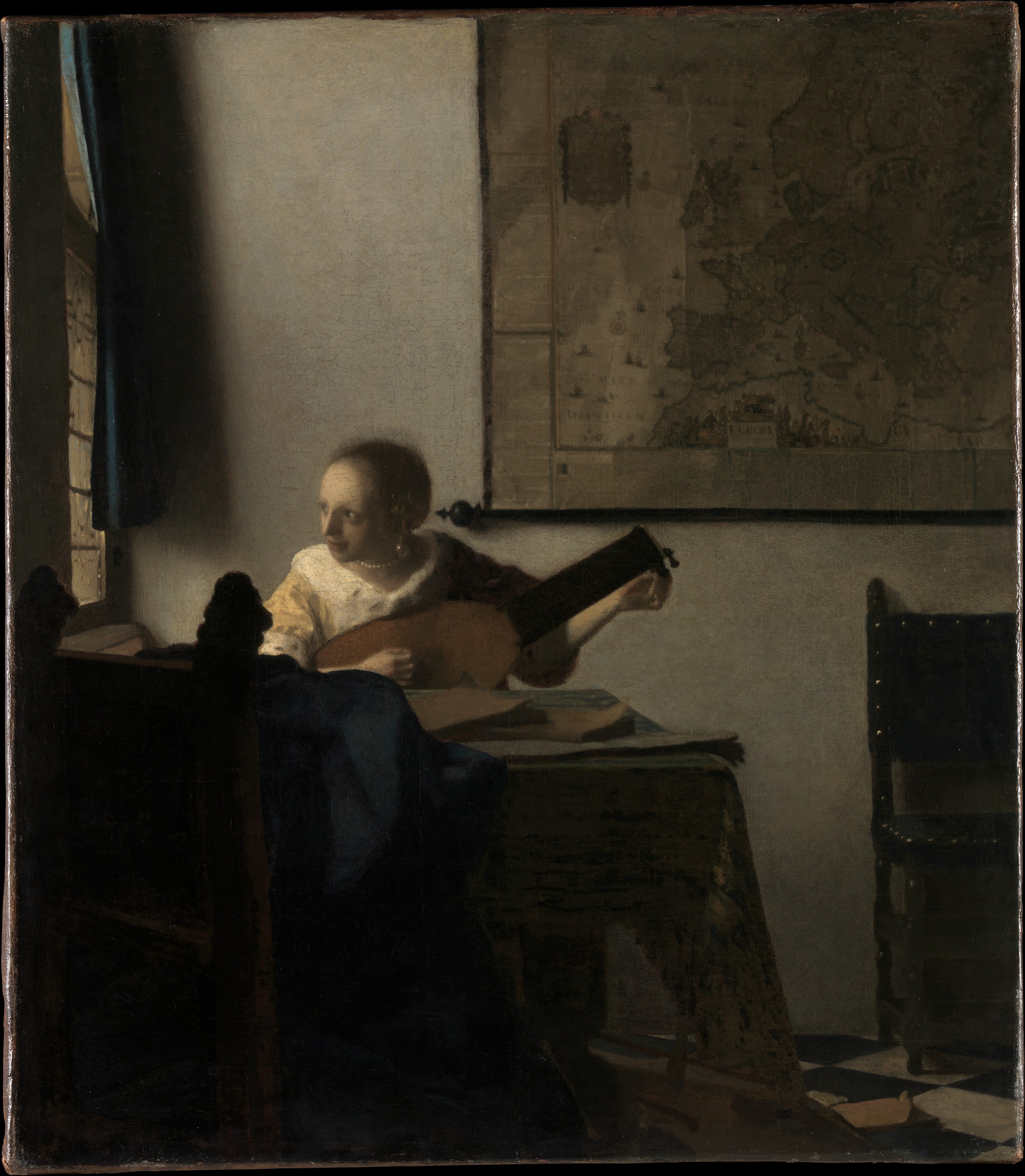
Johannes Vermeer's Young Woman with a Lute (c. 1662–63) offers a small but telling cross-section of this transformation: the young woman tunes her lute; open songbooks and a viola da gamba on the floor suggest preparation for a duet. The map of Europe behind her brings music, education, cartography and the maritime world of the Dutch Republic into the same domestic interior.

Johannes Vermeer, Young Woman with a Lute, c. 1662-63
Johannes Vermeer, Young Woman with a Lute, c. 1662–63. The Metropolitan Museum of Art / Wikimedia Commons, public domain (Open Access).
Details

Relation to the previous phase: The Request/Renaissance section already discusses the relative emancipation of art from exclusive Church and Court patronage and the formation of an art market. Rather than repeating that account, the Dutch Republic is used here as a concrete seventeenth-century example of how this earlier transformation became visible in representations of everyday and domestic life.

Check · patronage: The Met's chronology for the Low Countries, 1600–1800, notes the development of schools of painting in Dutch cities and identifies civic bodies and wealthy lay citizens, including merchants enriched by overseas trade, as key patrons. The Met · Low Countries 1600–1800 ↗

Check · image: The Met's object entry identifies the woman as tuning her lute, notes the songbooks and viola da gamba as signs of an anticipated duet, and explains that wealthy young people studied music. The Met · Vermeer, Young Woman with a Lute ↗

Image link: Clicking the image leads to the relevant object page at The Met rather than to the Commons file; Commons/Open Access information appears only in the caption.

1665–1704 NEWTON · SEEKING RATIOS BETWEEN MUSIC, SOUND AND COLOUR

Isaac Newton's early notebooks show an interest in the mathematical division of the musical scale. He later treated the propagation of sound through air mathematically in the Principia Mathematica, while in his optical work he drew proportional analogies between the colour spectrum and the diatonic musical scale.

Newton was conducting prism experiments from 1666 and published his first major results on light and colour in 1672. In the later Opticks (1704), he divided the spectrum into seven colour regions and used a diagram relating their extents to interval ratios in the musical scale. Musical ratio thus continued to function not only in the study of sound but as an analogy for thinking about the order of other physical phenomena.

Details

Earlier formulation: The older text noted that Newton “left the only opera he attended”, studied music theory closely, later used the musical scale to describe the spectrum, and failed to recognise that departure from a perfect octave constituted strong evidence for the wave nature of light.

Core retained: Newton's early musical studies and his colour–music proportional analogy are directly supported by the sources. Cambridge's Whipple Library notes his early work on the mathematical division of the musical scale, his mathematical treatment of sound propagation in the Principia, and his use of ratios between the seven colours and the diatonic scale in the Opticks. Whipple Library · Isaac Newton ↗

Primary text: Newton's Opticks explicitly describes a circle divided into seven colour regions in proportion to the seven musical tones or intervals. The Newton Project · Opticks, Book I Part II ↗

Why it was simplified: The opera anecdote was removed because it does not advance the main historical argument. The claim that Newton “failed to recognise the wave nature” compresses Pesic's wider interpretation and the complex history of corpuscular and wave theories into a single sentence, so it has not been retained in the main text. The degree to which the seven-colour scheme itself was caused by the musical analogy is also debated; the card therefore shows only the proportional relation Newton explicitly made.

Period boundary: Although Opticks was published in 1704, the card remains in the Reason Phase because Newton's principal prism experiments and colour theory developed in the 1660s–1670s. The year 1704 marks the later book publication of that work.

PHYSICS

1638–1687 FROM EXPERIMENT TO MATHEMATICAL LAW

One of the characteristic transformations of seventeenth-century physics was the growing effort to express individual experiments and mechanical problems as general relations among measurable quantities. The Request/Renaissance Phase already makes this experimental ground visible through Galileo's studies of motion and the pressure/vacuum experiments of Boyle, Pascal and Otto von Guericke.

Rather than repeating those developments in the Reason Phase, it is more useful here to follow how experimental findings were increasingly transformed into general mathematical laws involving quantities such as time, force, motion, elasticity and orbit. Huygens's work on pendulums and motion, Hooke's law of elasticity and Newton's Principia provide complementary examples of this transition.

Details

Previous-phase check: The Physics section of the Request/Renaissance Phase already includes Galileo's 1638 Two New Sciences, Robert Boyle's New Experiments Physico-Mechanical, Blaise Pascal's experiments on the void and Otto von Guericke's Magdeburg experiments. Those people and experiments are therefore not repeated as separate cards in the Reason Phase.

Galileo connection: Galileo's work on falling bodies and accelerated motion represents a major threshold in moving the study of motion from qualitative Aristotelian explanation toward measurable relations between time and distance. Museo Galileo · Law of Falling Bodies ↗

Focus of this phase: The older general statement that “scientific developments accelerated greatly” did not identify the transformation at stake. The main text has therefore been reframed around the conversion of experimental measurement into mathematical law and general mechanical principles.

1656–1673 CHRISTIAAN HUYGENS · PENDULUM, TIME AND DYNAMICS

Christiaan Huygens (1629–1695) greatly increased the precision of timekeeping in the mid-1650s by using the pendulum to regulate clocks. In his 1673 Horologium Oscillatorium, however, he moved beyond clock technology to analyse pendular motion mathematically.

The work became a powerful example of analysing motion in a physical device through quantities such as ideal geometrical form, period, length and circular motion. Precise timekeeping thus became not merely an aid to astronomy but a physical instrument for testing and formulating laws of motion.

Christiaan Huygens pendulum clock drawing
Early pendulum-clock drawing associated with Christiaan Huygens. Wikimedia Commons, public domain. Clicking the image opens the Smithsonian page for Horologium Oscillatorium.
Details

Added development: Huygens was absent from the older Physics note for the Reason Phase. Yet the connection between the pendulum clock and dynamics directly illustrates the period's movement from “measurement → mathematics → physical law”.

Source: Smithsonian Libraries describes the 1673 Horologium Oscillatorium as the work in which Huygens used mathematics and the dynamics of bodies in motion to explain how a pendulum could regulate a clock. Smithsonian Libraries · Horologium Oscillatorium ↗

Image-link principle: Although the image file is served through Commons, clicking it leads to the relevant Smithsonian work page rather than to the Commons file page.

1676–1678 ROBERT HOOKE · ELASTICITY AS A LAW

Robert Hooke (1635–1703) encoded a relation concerning springiness in an anagram in 1676 and made it explicit in his 1678 Lectures de Potentia Restitutiva, or Of Spring: the force applied to an elastic body and its extension stand in a proportional relation.

What is now called Hooke's law makes an important transformation in early modern physics visible: a qualitative property such as “springiness” becomes a generalizable mathematical relation between experimentally measurable quantities. The relation later became a foundational example in the mechanics of materials, vibration and engineering.

Details

Added development: Hooke was absent from the older Physics note for the Reason Phase. Yet the transformation of the force–extension relation from experiment into mathematical law is a particularly direct example for the chronology of this section.

Check: The American Institute of Physics explains that Hooke concealed the relation in an anagram in 1676 as a priority claim and published it openly in his 1678 Lectures de Potentia Restitutiva; in modern terms it expresses the proportionality between force and spring extension. AIP · Introducing Laws of Physics ↗

Duplicate check: Hooke's microscopy and biological observations are treated separately in the Biology section of the Reason Phase. This card is limited to elasticity and mechanical law and does not repeat that material.

1679–1684 THE ORBITAL PROBLEM · HOOKE, WREN, HALLEY AND NEWTON

Newton's 1687 synthesis did not emerge in isolation. From 1679, correspondence between Robert Hooke and Newton, followed by discussions among Hooke, Christopher Wren and Edmond Halley early in 1684, made the relation between an inverse-square force and planetary orbit into a central mathematical problem.

When Edmond Halley visited Newton in Cambridge in August 1684 and put the problem to him, Newton was prompted to prepare the short tract De motu corporum in gyrum later that year, beginning the path toward the Principia. The episode also makes visible that physical knowledge formed not only through individual genius but through the circulation of questions, correspondence, debate and mathematical proof.

Details

Why it was added: The older text presented Newton almost as the sole starting point of the development. Without diminishing Newton's achievement, making the circulation of the problem among Hooke, Wren and Halley visible gives a more accurate picture of how scientific knowledge formed.

Check: The Newton Project records that Halley, Hooke and Wren discussed orbital dynamics and the inverse-square force early in 1684; after Halley's visit to Newton, Newton sent the short De motu corporum in gyrum around November 1684. Newton Project · Principia-related texts ↗

Boundary with the Astronomy column: The Astronomy importer already treats 1687 as the threshold where celestial observation and calculation join physical law. This Physics card therefore does not repeat the planetary model; it focuses on the formation of the force–motion problem as a scientific and mathematical problem.

1687 ISAAC NEWTON · PRINCIPIA AND GENERAL MECHANICS

Isaac Newton (1642–1727) brought the three laws of motion and the theory of universal gravitation into a common mathematical framework in the 1687 Philosophiæ Naturalis Principia Mathematica —Mathematical Principles of Natural Philosophy.

One of the most important consequences was that falling or projected bodies on Earth and the motions of the Moon and planets could now be investigated not as two separate domains of nature but through the same principles of motion and force. Mechanics thus began to develop beyond the knowledge of particular machines into a mathematical physics of motion under general principles.

Title page of Newton's Principia Mathematica, 1687
Newton, Philosophiæ Naturalis Principia Mathematica, 1687, title page. Wikimedia Commons, public domain. Clicking the image opens the work record at the Newton Project.
Details

Correction of Newton's institutional role: Newton did not hold a post at Cambridge simply titled “physicist”, nor was he a lecturer for the Royal Society. He became Lucasian Professor of Mathematics in 1669, was elected a Fellow of the Royal Society in 1672, and became its President only in 1703. University of Cambridge · Newton manuscripts collection ↗

Three laws: The older wording counted “three laws of motion plus one law of universal gravitation” as four equivalent laws. The Principia explicitly presents three Leges Motus; universal gravitation is the broader physical theory developed through those principles in the later parts of the work. Newton Project · Leges Motus ↗

Calculus correction: Newton developed his own method of “fluxions” in the 1660s, while Leibniz independently developed calculus and published a different notation. Yet most of the published demonstrations in the Principia are presented through geometrical methods of limits and ratios. The simple statement that “Newton invented calculus in order to derive these laws” has therefore not been retained.

Title correction: Philosophiæ Naturalis Principia Mathematica is rendered as “Mathematical Principles of Natural Philosophy”, rather than the earlier mistranslation implying “mathematical principles for philosophers”.

1692–1693 NEWTON · MECHANICAL EXPLANATION AND DIVINE ORDER

Newton's study of nature and his theological interests were not two unrelated parts of his life. Yet it is misleading to say, as the older text did, that “celestial bodies failed to obey Newton's laws, so he turned to theology and argued that God continually corrected the system”.

In his 1692–1693 letters to Richard Bentley, Newton explicitly argued that although gravity could account for certain motions, the initial arrangement, directions of rotation and transverse motions of the planets could not, in his view, be derived adequately from mechanical principles alone; he related them to a divine ordering cause. What is significant here is that mathematical natural law did not remove metaphysical and theological questions for Newton; it made him distinguish between what the law explained and what he believed remained beyond that explanation.

Details

Earlier formulation: “But in observations the celestial bodies did not move entirely according to Newton's laws. Newton became interested in theology in order to understand this and argued that God intervened in the Solar System to maintain it.”

Correction: Newton's theological work did not begin because of an observational mismatch in the Principia; he was already deeply engaged in theology during the 1670s. His argument in the Bentley letters of 1692–1693 is more specific: Newton held that gravity might direct planets toward the Sun but that their transverse orbital motions and initial arrangement could not be derived from gravity alone. Newton Project · letter to Bentley, 10 December 1692 ↗; letter of 11 February 1693 ↗

Caution: Later Newtonian mechanics and eighteenth-century celestial mechanics would turn planetary stability and perturbations into much more developed mathematical problems. Those later developments are left to the Euler–d'Alembert–Lagrange–Laplace sequence already present in the Spirit Phase.

BIOLOGY

c. 1600–1700 THE MICROSCOPE · THE SCALE OF THE LIVING WORLD CHANGES

During the seventeenth century, increasingly effective use of the microscope produced a change of scale in biology comparable to the role of the telescope in astronomy. Tissues, minute organisms and details of living structures invisible to the unaided eye became observable objects of investigation.

The inventor of the first compound microscope is not known with certainty. The traditional attribution to Dutch spectacle makers Hans and Zacharias Janssen around 1590 is widespread, but the evidence is late and disputed, so it is safer not to present this as a settled invention claim.

Details

Earlier formulation: The older text listed Zacharias and Hans Janssen, Leonard Digges and Thomas Digges as pioneers in the invention of the microscope.

Correction: The attribution to the Janssen family remains disputed in the historiography; the Science Museum Group likewise notes that early compound microscopes are traditionally attributed to Zacharias Janssen and his father, while explicitly stating that the claim is contested. The Digges family is important in the history of telescopic and optical experimentation, but there is insufficient basis for presenting them as definite inventors of the microscope, so they have been removed from the main text. Science Museum Group · compound microscope ↗

Previous-phase check: Vesalius, Leonardo, Paracelsus and early empirical anatomy/natural history are already treated in the Request/Renaissance Phase. Their Renaissance origins are therefore not repeated here; the focus shifts to the seventeenth-century expansion of observation into new scales of living structure.

1628 WILLIAM HARVEY · EXPERIMENTAL DEMONSTRATION OF CIRCULATION

William Harvey (1578–1657), in his 1628 Exercitatio Anatomica de Motu Cordis et Sanguinis in Animalibus, argued through experiment and quantitative reasoning that the heart pumps blood and that blood moves continuously around the body in a circulation.

The work strongly challenged inherited Galenic ideas that blood was continually produced in the liver and became an important threshold for the experimental investigation of physiological function.

Details

Important correction: The older text stated that Harvey “discovered the capillaries”. Harvey demonstrated the circulation of blood, but he could not directly see the microscopic connection between arteries and veins. That connection became visible later through Marcello Malpighi's observations of capillaries in frog lungs.

Institutional source: The Royal College of Physicians notes that after roughly a decade of research Harvey published in 1628 the idea that the heart pumps blood continuously around the body and supported it experimentally. RCP Museum · Ceaseless Motion ↗

Relation to the previous phase: Vesalius's 1543 reconstruction of anatomy through direct dissection remains in the Request/Renaissance Phase. Harvey represents the seventeenth-century extension of that approach from structure toward function.

1648 JAN BAPTIST VAN HELMONT · MEASUREMENT, PLANT GROWTH AND “GAS”

Jan Baptist van Helmont (1579–1644)'s Ortus medicinae, published posthumously by his son in 1648, is an early modern work bringing chemistry, medicine and physiology into close contact.

Van Helmont's famous five-year willow experiment compared the large gain in plant mass with the very small loss of soil mass, turning growth into a problem of quantitative measurement. His conclusion that the plant's substance came from water alone was nevertheless incorrect. Van Helmont is also remembered for introducing the term “gas” into scientific vocabulary.

Details

Earlier formulation: The older text described van Helmont's experiment as demonstrating that “plants are nourished only by water”. That was van Helmont's historical interpretation; it should not be presented as what the experiment actually established.

Publication correction: Ortus medicinae was published in 1648 after van Helmont's death by his son Franciscus Mercurius van Helmont. Wellcome Collection · Ortus medicinae ↗

Interdisciplinary position: Van Helmont is significant to iatrochemistry and early pneumatic chemistry as well as to the life sciences. Because FDBM has no separate chemistry column, he is retained here as an early example of treating living processes chemically and quantitatively.

1660–1661 MARCELLO MALPIGHI · CAPILLARIES AND MICROANATOMY

Marcello Malpighi (1628–1694) was one of the principal seventeenth-century investigators to use the microscope systematically on the fine structure of living tissues. In 1660–61 he observed blood passing through extremely small vessels in the frog lung, making visible the capillary connection between arteries and veins.

The observation completed the previously unseen link in Harvey's model of circulation. Malpighi also investigated the microscopic organisation of structures such as lungs, kidneys, skin and chick embryos, contributing decisively to the development of microanatomy and histology.

Lung illustration from Malpighi's De pulmonibus
Marcello Malpighi, De pulmonibus, lung and microscopic vessel observations. Image: local FDBM copy; clicking opens the relevant Internet Archive page of the work.
Details

Correction · Harvey/Malpighi: The discovery of capillaries should be associated with Malpighi rather than Harvey. Sources distinguish between the observation in 1660 and publication in 1661; the card therefore uses the range “1660–1661”.

Primary source: digital copy of De pulmonibus ↗

Image link: The image file is hosted on the FDBM server; clicking it leads directly to the relevant page of the work rather than to an image repository.

1665 ROBERT HOOKE · MICROGRAPHIA AND THE “CELL”

Robert Hooke (1635–1703)'s Micrographia (1665) opened the microscopic world to a broad readership through detailed visual documentation. Comparing the small compartments he saw in cork to the cells of a honeycomb, Hooke used the word “cell” for them.

Hooke had not yet established the modern biological concept of the living cell; what he observed in cork were empty cell-wall compartments. Even so, Micrographia marks a major threshold in the history of the term “cell” and in the systematic visualisation of microscopic structure.

Microscopic illustration from Robert Hooke's Micrographia
Robert Hooke, Micrographia (1665). Image: local FDBM copy. The link leads directly to the Royal Society record for the relevant Micrographia material.
Details

Important correction: The older claims that Hooke “invented the microscope in 1665” and was “the first person to visualise a microorganism” have been removed. Hooke did not invent the microscope. The historical threshold is his improvement and systematic use of the instrument, the visual publication of his observations in Micrographia, and his use of the word “cell” for the compartments in cork.

Royal Society check: The Royal Society treats Micrographia as a landmark in microscopy and explicitly notes Hooke's use of the word “cell” for the small pores he observed in cork. Royal Society · Restoration Reading ↗

Previous-phase check: Hooke also appears in the older Request-Phase material for his physical and optical work. This card retains only the biology-specific Micrographia–cell connection; his physical work is not repeated.

1668 FRANCESCO REDI · AN EXPERIMENTAL CHALLENGE TO SPONTANEOUS GENERATION

Francesco Redi (1626–1697), in his 1668 Esperienze intorno alla generazione degli insetti, tested whether maggots on decaying meat arose spontaneously by comparing containers that differed in their exposure to flies.

The absence of maggots when flies could not reach the meat provided strong experimental evidence against spontaneous generation in this case. The historical significance lies in testing an inherited explanation by deliberately changing conditions in a comparative experiment.

Details

Cautious correction: The older statement that Redi “invalidated the theory of spontaneous generation” was too broad. His experiment showed specifically that maggots did not arise spontaneously from decaying meat; broader debates about the origin of microscopic life continued into later centuries.

Experimental design: The comparison of open, sealed and gauze-covered containers is an early clear example of deliberately organised control conditions in biological experiment. OpenStax Microbiology · spontaneous generation ↗

1669–1670s JAN SWAMMERDAM · CONTINUITY IN INSECT DEVELOPMENT

Jan Swammerdam (1637–1680) used microscopic dissection techniques to investigate insect development. Through detailed anatomical observations he showed that larva, pupa and adult were not separate creatures but different developmental stages of the same organism.

Swammerdam's significance was not merely in seeing new detail but in interpreting metamorphosis not as sudden creation or transformation into a wholly different being, but as the gradual development of structures already present.

Details

Earlier formulation: The priority claim that Swammerdam was the “first observer” of red blood cells has not been retained in the main card; his more distinctive contribution to the history of biology lies in insect development and microscopic dissection.

Check: Swammerdam's detailed dissections allowed him to show that adult insect structures began developing beneath the larval skin and to interpret metamorphosis as a continuous developmental process. Oxford Academic · history of insect metamorphosis ↗

1674–1677 ANTONI VAN LEEUWENHOEK · MICROORGANISMS BECOME VISIBLE

Antoni van Leeuwenhoek (1632–1723) examined water, dental material, plant and animal tissues and many other specimens with high-quality single-lens microscopes of his own making. From the mid-1670s onward, letters sent to the Royal Society described previously unknown minute living beings that he called “animalcules”.

In his letter of 9 October 1676 he described several kinds of microscopic organisms in pepper-water and different water samples, at least one of which may correspond to bacteria. The living world could now be observed directly to extend far beyond organisms visible to the naked eye.

Details

Missing central figure: The older Reason-Phase text mentioned Leeuwenhoek only within a general paragraph on microscopy but did not give him a separate heading. Because the observation of microscopic life is one of the defining developments of the section, it has been given its own card.

Primary archive: The Royal Society record for Leeuwenhoek's letter of 9 October 1676 describes different “animalcules” observed in pepper-water and in rain, well, moat, sea and river water, noting that one may have been a bacterium. Royal Society · Leeuwenhoek letter, 1676 ↗

1674–1681 MAYOW AND BORELLI · CHEMICAL AND MECHANICAL FUNCTIONS OF THE LIVING BODY

John Mayow (1641–1679), in his 1674 Tractatus quinque medico-physici, investigated respiration, air, muscular motion and an active component of air he called the “nitro-aerial spirit”. His view that combustion and respiration consume the same active part of air was an early but incomplete step toward later oxygen chemistry.

Giovanni Alfonso Borelli (1608–1679)'s De Motu Animalium, published posthumously in 1680–81, analysed muscles, bones and animal movement through levers, forces and mechanical principles. It is widely regarded as a foundational early text of biomechanics.

Details

Mayow: The older idea that Mayow came unusually close to the later concept of oxygen can be retained cautiously, but the modern oxygen concept should not simply be projected backward onto him. Wellcome's record confirms that the 1674 work treats the nitro-aerial spirit, respiration, fetal respiration and muscular motion. Wellcome Collection · Mayow ↗

Borelli: The older statement that Borelli “investigated the microscopic structure of red blood cells” has not been retained in the main card. His much clearer historical contribution is De Motu Animalium, which analyses animal movement mechanically. Historical assessments in Springer and PubMed identify it as one of the earliest major treatises of biomechanics. PubMed · Borelli / biomechanics ↗

FDBM connection: At the same time that the Physics column shows nature increasingly explained through mechanical laws, the Biology column shows living functions becoming open to chemical and mechanical explanation.

1682–1694 GREW AND CAMERARIUS · PLANT INTERNAL STRUCTURE AND SEXUAL REPRODUCTION

Nehemiah Grew (1641–1712)'s The Anatomy of Plants (1682) compared the internal structure of roots, stems, leaves, flowers, fruits and seeds through naked-eye and microscopic observation. Detailed drawings made the organisation of plant tissues visible, while his observations of pollen and floral structures helped prepare the ground for understanding plant reproduction.

Rudolf Jacob Camerarius (1665–1721) provided experimental evidence for sexual reproduction in plants in 1694. By the end of the century, microscopic observation of structure was thus expanding from description toward the experimental investigation of reproductive function.

Plant anatomy illustration from Nehemiah Grew's The Anatomy of Plants
Nehemiah Grew, The Anatomy of Plants (1682). Image: local FDBM copy; the link leads directly to the work's Wellcome Collection page.
Details

Grew check: Wellcome and the Biodiversity Heritage Library confirm the 1682 publication of The Anatomy of Plants and its extensive engraved plates. Grew's work is concerned not merely with classification but with how the plant is organised and functions. Biodiversity Heritage Library · The Anatomy of Plants ↗

Plant sexuality: Grew and contemporaries discussed the reproductive role of floral organs; Cambridge's Department of Plant Sciences notes that this idea was reinforced by Camerarius's experimental evidence in 1694. Cambridge Plant Sciences ↗

Image link: The image links directly to the page for Grew's work rather than to Commons.

ARCHITECTURE

early 17th century ARCHITECTURE OF THE EURASIAN POWER BLOC AROUND 1600

By the seventeenth century, the Eurasian world stretching from Japan to Western Europe formed a large economic field linked by reliable overland and coastal trade. Wealth and ideas travelled in the belongings and minds of merchants, migrants, envoys and armies; architectural knowledge, materials and craftsmanship moved through the same networks.

This Old World order, however, was beginning to come under pressure from increasingly efficient oceanic trade. Industrialisation and access to the Americas would make European global dominance much more pronounced in the nineteenth century, but around 1600 the older centres of Eurasian power still remained major poles of the world economy. For that reason, it seems meaningful to read the architecture of this period not from Europe alone, but together with contemporary Japan, China, Tibet, India, Iran, the Ottoman world and Russia.

Source: Francis D. K. Ching, Mark M. Jarzombek and Vikramaditya Prakash, A Global History of Architecture.

1603–1636 JAPAN · TOKUGAWA, GATES AND POWER

At the beginning of the seventeenth century, the Tokugawa shoguns unified Japan after roughly a century of civil war and political fragmentation and established a relatively stable order. As major shrines and temples in Kyoto continued to be rebuilt, architecture became one of the principal means through which political hierarchy was made visible.

The relationship between power and architecture can even be seen encoded in Japanese language: mon, “gate,” forms part of kenmon, a term for a person of authority and literally something like “power gate.” Mikado, used in reference to the emperor, means “honourable gate,” while kinmon, “prohibited gate,” was associated with the restricted imperial palace. The Yōmei-mon at Nikkō Tōshō-gū is a spectacular example of this ceremonial and graduated order of access.

Yomeimon gate at Nikko Toshogu
Nikkō Tōshō-gū, Yōmei-mon.

By contrast, the older aristocratic families, now largely deprived of political power, adopted a more introspective and pseudo-rustic aesthetic influenced by Zen ideals, unlike the sumptuous displays of shogunal authority. The Katsura Imperial Villa became one of the best-known expressions of this contrast.

Source: Francis D. K. Ching, Mark M. Jarzombek and Vikramaditya Prakash, A Global History of Architecture.

Details

Important correction: The earlier wording suggested that the shoguns were the group that had lost power. In the principal source, it is the older aristocratic families who had become largely disempowered, while the shoguns staged authority through sumptuous architecture. The text has been retained with that meaning corrected.

1573–1620 CHINA · MING BUREAUCRACY AND THE WANLI TOMB

In China, the institutional bureaucracy of Ming government provided a powerful structure for the continuity of imperial order. Although the Wanli Emperor (r. 1573–1620) is known to have withdrawn increasingly from court affairs in the later part of his reign, the immense imperial apparatus continued to function.

Wanli's tomb makes visible the monumental and cosmological character of the Ming tomb tradition. The tumulus, approach axis, gates, thresholds and mountain profile beyond can be read as a single symbolic arrangement. The underground chambers also show how masonry vaulting, in a culture whose above-ground architecture remained predominantly timber-framed, was used especially for tomb construction. Power, ritual, landscape and building thus become parts of one composition.

Source: Francis D. K. Ching, Mark M. Jarzombek and Vikramaditya Prakash, A Global History of Architecture.

Details

Correction: Claims that imperial prosperity was essentially unaffected, and the precise quantity of silver supposedly spent on the tomb, were removed from the main card because such quantitative claims vary by source. The more architecturally informative relationship among axis, threshold, mountain and tomb is emphasised instead.

after 1645 TIBET · THE POTALA PALACE

Buddhism had taken root in Tibet from the eighth century onward through monks travelling from India and Nepal. In the seventeenth century, as the spiritual and political authority of the Fifth Dalai Lama, Ngawang Lobsang Gyatso, was consolidated, Lhasa was re-centred; from 1645 the Potala Palace rising on Red Hill became both the spiritual and political residence of this new order.

Set on a rocky projection in the Himalayan landscape, the great mass can be read from afar through its thick white walls, dark windows, increasingly elaborate upper levels, the Red Palace and the long ramps climbing the hill. The building does not merely occupy the topography; it turns topography into an architectural hierarchy. Its association with Mount Meru, the conceptual centre of the Buddhist cosmos, is therefore particularly meaningful.

Potala Palace
Potala Palace, Lhasa.

Source: Francis D. K. Ching, Mark M. Jarzombek and Vikramaditya Prakash, A Global History of Architecture.

Details

Correction: Problems in the older wording concerning “1461” and the name of the Fifth Dalai Lama were removed. His name and the post-1645 building campaign of the Potala were placed in the correct chronology. The phrase corresponding to “New Mountain” was corrected to the intended concept, Mount Meru.

1570 → 1632–1653 MUGHAL ARCHITECTURE · FROM HUMAYUN’S TOMB TO THE TAJ MAHAL

Built in Delhi in the late 1560s through the initiative of Humayun's widow Haji Begum, Humayun's Tomb brought together Persian garden-tomb traditions and Mughal architecture and became an important precursor of the development that would later culminate in the Taj Mahal.

The mausoleum commissioned by Shah Jahan for his wife Mumtaz Mahal at Agra was known to the Mughals as the Rauza-i Munavvara, the “Illumined Tomb,” because of the lustre of its marble. Its design and construction depended on a network of specialists too broad to reduce to a single name: sources mention expertise in dome construction, calligraphy, mosaic/inlay, stone cutting and metalwork from regions including the Ottoman world, Lahore, Shiraz, Bukhara, Syria, South India and Baluchistan. In this sense, the Taj Mahal was a global project.

Shah Jahan appears to have followed the project closely and approved major decisions, yet it is more cautious to speak of a layered design and construction organisation under imperial patronage than to declare him the sole “chief architect.”

Taj Mahal
Taj Mahal, Agra.

Source: Francis D. K. Ching, Mark M. Jarzombek and Vikramaditya Prakash, A Global History of Architecture.

Details

Corrections: Humayun's Tomb was placed in its Mughal rather than Delhi Sultanate context, and the name of Haji/Bega Begum was normalised. The principal source's account of a large creative nucleus of specialists was retained, while the conclusion that “Shah Jahan should be recognised as chief architect” was made more cautious.

1571–1585 DIWAN-I KHAS · SPATIALISING A PHILOSOPHICAL IDEAL

Akbar's Diwan-i-Khas at Fatehpur Sikri is a singular building in architectural history. Although he was unable to read and write, Akbar was intensely curious about the diversity of beliefs and ideas within his empire and gathered thinkers of different religions around him. At the centre of the intellectual search associated with the Din-i-Ilahi, proclaimed in 1582, stood sulh-i-kul: a principle of general peace or tolerance toward differing ideas that benefit humankind.

From the outside, the building appears as a two-storey square box of red sandstone with four corner chhatris. Its width and height to the tops of the chhatris are approximately equal, making it symbolically close to a cube. The real “theatre,” however, is inside: in the exact centre of the double-height volume a single column blossoms into mushroom-like stone brackets supporting a circular platform. Narrow bridges connect this platform to the four corners, while a balcony runs around the upper level.

By placing the emperor at the centre of the building in both plan and section, the architecture turns into space the idea of a centre equidistant from different philosophical and religious positions. The Diwan-i-Khas can therefore be read not merely as an audience hall but as an architectural diagram of an intellectual position—even as a theoretical project in which a philosophical ideal is spatialised directly. It had no clear known precedent and was not repeated in the same form.

Diwan-i-Khas at Fatehpur Sikri
Diwan-i-Khas, Fatehpur Sikri.

Source: Francis D. K. Ching, Mark M. Jarzombek and Vikramaditya Prakash, A Global History of Architecture.

Details

Ching–Jarzombek–Prakash interpret the emperor's position at the centre of the cube and conceptual sphere as a centre equidistant from all philosophical positions in the Din-i-Ilahi.

after 1598 ISFAHAN · SQUARE, COMMERCE AND CAPITAL

Shah Abbas's transfer of the capital to Isfahan in 1598 accelerated a major rebuilding that turned the city into the political, commercial and artistic focus of the Safavid world. Naqsh-e Jahan Square became an urban centre organising palace, mosques, bazaar and ceremonial space together; the commercial fabric around the square joined state representation and everyday exchange within the same spatial system.

The city quickly became a cosmopolitan centre visited by English and Dutch merchants, European diplomats and artists. The saying “Isfahan nesf-e jahan”—“Isfahan is half the world”—expresses this image of wealth and centrality.

Naqsh-e Jahan Square Isfahan
Naqsh-e Jahan Square, Isfahan.
Drawing of Naqsh-e Jahan Square by Pascal Coste
Pascal Coste, drawing of Naqsh-e Jahan Square, nineteenth century.

Source: Francis D. K. Ching, Mark M. Jarzombek and Vikramaditya Prakash, A Global History of Architecture.

Details

Correction: The vague phrase that Isfahan was “rebuilt between Tehran and Fars” was removed. Rather than reducing the square to a competition of dimensions, the integrated relation among square, bazaar, palace and mosque is emphasised.

1550–1557 · precursor within the 1600 horizon THE SÜLEYMANİYE COMPLEX · SINAN, CITY AND NETWORKS OF PRODUCTION

During the reign of Süleyman the Magnificent, Mimar Sinan stood at the centre of a long architectural practice that transformed Istanbul through mosques, bridges, waterworks, palaces and charitable institutions. A contemporary of Michelangelo and Palladio, Sinan's production in Istanbul formed an urban continuity much broader than a collection of isolated monuments.

The Süleymaniye Complex is one of the principal examples of this approach. Rather than simply copying the great domed space of Hagia Sophia, Sinan brought together Seljuk emphasis on portals, Anatolian stone craftsmanship, and the structural logic of Byzantine domes into a new unity. Around the mosque, the külliye assembled four madrasas, medical and charitable facilities, an imaret, caravansary, bath and market, making architecture part of the city's everyday network of services.

The construction process itself drew on a wide geography: tiles were produced in Iznik; carpets in Anatolia and Egypt; coloured and clear glass in Venice; limestone and granite came from the Marmara region, while part of the metalwork came from the Balkans. The complex therefore reveals the Ottoman capital not only formally but as a system that joined networks of craft, material and labour.

Süleymaniye Complex
Süleymaniye Complex, Istanbul.

Source: Francis D. K. Ching, Mark M. Jarzombek and Vikramaditya Prakash, A Global History of Architecture.

Details

Date correction: The older wording that the complex “began in 1599” was incorrect. The Süleymaniye Complex was built in 1550–1557; the main card uses this date range.

1475–1508 · precursor within the 1600 horizon THE KREMLIN’S NEW CHURCHES · ORTHODOXY AND TRANSFER OF KNOWLEDGE

The Russian Church rejected the Byzantine Church's attempt at reunion with Rome at the Union of Florence in 1439 and, after the fall of Constantinople, increasingly claimed a major political role as a defender of Orthodox tradition. This religious renewal coincided with the consolidation of political power around Moscow as Mongol domination fragmented.

Under Ivan III, architects and engineers were invited from Italy from 1475 onward to assist a major building programme. The most important undertaking was the reorganisation of the fortifications, palaces and cathedrals of the Moscow Kremlin, which had long served as the seat of government. Renaissance technical knowledge imported from abroad was thus reinterpreted within a Russian Orthodox language of representation.

Moscow Kremlin cathedrals
Moscow Kremlin and its cathedral ensemble.

Source: Francis D. K. Ching, Mark M. Jarzombek and Vikramaditya Prakash, A Global History of Architecture.

1570 PALLADIO · PLAN, SECTION, ELEVATION AND SYSTEM

Andrea Palladio (1508–1580) distinguished himself by developing much of his work not only in the city of Venice but on the agricultural mainland around Vicenza and the Veneto. His villas were not merely country retreats for urban elites; many were working farms integrated with production, storage and agricultural circulation. Architectural order and everyday economic use were therefore joined within a single composition.

Villa Foscari became one of the models that exerted a long influence on palaces, villas and houses across Europe and later the Americas. Palladio's I quattro libri dell'architettura—The Four Books of Architecture—published in 1570, presented the classical system not simply as a repertory of forms but as systematic design knowledge linking building type, plan, section, elevation, proportion and site.

Compared with Serlio's wider repertory of possible combinations, Palladio's approach can appear more restricted and ordered, yet its precision did not produce monotony. Interior plan, façades, terrain, approach, agricultural outbuildings, villages and enclosure walls became parts of a larger composition rather than isolated objects. One reason for Palladio's long influence was precisely his ability to sustain system and invention together.

Palladio 1570 plan and elevation engraving
Andrea Palladio, plan and elevation, I quattro libri dell'architettura, 1570.

Source: Francis D. K. Ching, Mark M. Jarzombek and Vikramaditya Prakash, A Global History of Architecture.

Details

Important correction: The older date “1452” and the statement that “the book had no drawings” were incorrect. I quattro libri was published in 1570, and numerous woodcut plans, elevations, sections and details were central to the explanatory method of the book. Records at The Metropolitan Museum of Art and the Palladio Museum confirm this directly.

Repetition check: The account of classical orders already treated in the Renaissance Phase is not repeated. Palladio is retained here for his systematic design method and Palladian influence extending into the seventeenth and eighteenth centuries.

1620–1700 BAROQUE ITALY · FROM ROME TO THE CAPITALS OF EUROPE

The Baroque developed in Rome especially within the visual and ceremonial language of the Counter-Reformation. Giovanni Lorenzo Bernini (1598–1680) and Francesco Borromini (1599–1667) were among the architects who reformulated architecture through movement, light, curved surfaces, theatrical staging and urban approach rather than treating the building as a static classical object.

It remains important to preserve the difference between Roman Baroque and the broader European Baroque. After the middle of the seventeenth century, with the political rise of France and Austria, Baroque expanded into palaces, châteaux, public parks, waterworks and long landscape perspectives. At Vaux-le-Vicomte, Place Vendôme and later Schönbrunn, architecture moved beyond the scale of the single building toward broader compositions staging approaches, gardens and the city.

By the end of the seventeenth century this new scale had become visible in the urban identities of Rome, Paris, London and Vienna. A negative consequence of the same “modernising” impulse was that many medieval buildings were transformed with new Baroque façades or interiors.

St Peter's Square
St. Peter's Square, Rome.

Source: Francis D. K. Ching, Mark M. Jarzombek and Vikramaditya Prakash, A Global History of Architecture.

Details

Terminology note: “Baroque” was not the period's own self-designation; the label became established later. It is used here as a useful historiographic term for particular architectural attitudes of the seventeenth century.

after 1492 · 16th–17th centuries SPANISH CONQUEST OF THE AMERICAS · EXCHANGE, COERCION AND HYBRID ARCHITECTURE

At the end of the fifteenth century, Spain's search for an Atlantic route to eastern markets initiated a vast transformation that culminated in the conquest and colonisation of the Americas. A significant part of the silver extracted from the Americas became connected through Europe to Asian trade, especially to China where demand for silver was high. The economic world within which architecture developed therefore began to shift from Mediterranean and overland networks toward Atlantic and oceanic routes.

This process involved far more than bullion and money. Potatoes, maize, peppers, vanilla, tobacco and other American products entered Europe and increasingly global diets, while wheat, rice, coffee, citrus fruits, animals and Eurasian-African agricultural systems were transferred to the Americas. This immense biological and economic circulation transformed landscapes, modes of production, settlements and building types.

Spanish colonisation advanced together with the coercive spread of Christianity, yet the resulting world of churches and monasteries was not a one-directional copy. Indigenous songs, dances, visual traditions, craftsmanship and spatial habits combined in different ways with Catholic ritual. Open atrio arrangements and church spaces adapted to relations with Indigenous communities became early expressions of the distinctive hybrid character of Latin American architecture.

Source: Francis D. K. Ching, Mark M. Jarzombek and Vikramaditya Prakash, A Global History of Architecture.

Details

Correction and caution: The precise bullion tonnage and some long commodity lists in the older text were simplified. Rather than generalising that Indigenous civilisations across the continent were “almost completely destroyed,” the text uses more careful language about the severe devastation of many Indigenous societies through epidemic disease, warfare, forced labour, displacement and political domination.

16th–18th centuries COLONIAL FORTS · INFRASTRUCTURE OF TRADE AND EXTRACTION

Colonial powers built numerous forts and fortified compounds along the coasts of Africa, Asia and the Americas to protect ports, maritime trade and extractive economies. These structures were not merely military objects for defence in wartime; they functioned as commercial-administrative nodes controlling the movement of goods, people and coerced labour.

Fortifications such as Elmina on the West African coast, European strongholds in the Indian Ocean and South Asia, and Atlantic forts reveal how architecture increasingly became infrastructure for a global system of extraction. Bastioned geometry also records the transfer of European fortification knowledge, developed for artillery warfare, across continents.

Fort William colonial fortification
Fort William, Kolkata.

Source: Francis D. K. Ching, Mark M. Jarzombek and Vikramaditya Prakash, A Global History of Architecture.

Details

Date note: The Fort William image can be used to teach the general type, but the principal Fort William visible today is the product of a mid-eighteenth-century rebuilding. It is therefore not presented as a direct example from the 1600s.

17th century AMSTERDAM · CANAL CITY, COMMERCE AND CIVIC ARCHITECTURE

With the rise of the Dutch Republic, Amsterdam became one of Europe's principal international ports and financial centres in the seventeenth century. Its architectural character differed markedly from traditional capitals organised around royal palaces and great monasteries. Rows of townhouses, warehouses, parallel streets and canals formed an urban fabric directly connected to commerce and everyday production.

The planned expansion of the canal belts joined water management, transport, land development and housing within a single system. The Wisselbank, founded in 1609, strengthened the city's new institutions as it acquired major importance in European finance. It is also significant that the bank occupied the Amsterdam Town Hall begun by Jacob van Campen in 1648: symbols of global trade and maps of the world were represented within civic architecture rather than a royal palace.

Daniel Stalpaert map of Amsterdam 1662
Daniel Stalpaert, map of Amsterdam, 1662.

Source: Francis D. K. Ching, Mark M. Jarzombek and Vikramaditya Prakash, A Global History of Architecture.

Details

A Global History of Architecture draws attention to the way Amsterdam's new commercial city produced an urban fabric different from cities dominated by palaces, monasteries and castles. Because the colonial economy was multi-actor and complex, this relationship is not reduced to a single country.

1605–1614 PARIS · PLACE ROYALE AND PLACE DAUPHINE

After the economic and political disturbances of the sixteenth century, Henry IV initiated a series of urban projects intended to reinforce Paris as the capital of a centralising French state. The triangular Place Dauphine (1609–14), at the western tip of the Île de la Cité, was designed in part to provide accommodation for bankers and merchants.

The other important experiment was the Place Royale—today's Place des Vosges. Begun around 1605, it was originally conceived with shops and apartments on three sides and silk-production workshops on the fourth. Although the silk programme did not endure, the square attempted to bring the economic and ceremonial life of the capital within a single geometric frame through regular façades, a clearly defined open space and the combination of residence and commerce.

Place des Vosges plan
Place Royale / today's Place des Vosges.
Historical plan engraving of Place Royale
Plan de la place Royale, historical plan/engraving.

Source: Francis D. K. Ching, Mark M. Jarzombek and Vikramaditya Prakash, A Global History of Architecture.

Details

Important correction: The older heading “PALACE ROYAL” combined with “today Place des Vogues” mixed two different places. The example here is the Place Royale, today the Place des Vosges. The Palais-Royal is a separate palace and urban complex.

1558–1603 ELIZABETHAN ENGLAND · GLASS, THE HOUSE AND THE ATLANTIC SHIFT

During the reign of Elizabeth I, England increasingly benefited from the shift of economic weight from the Mediterranean toward the Atlantic. Maritime activity, wool and textile trade, production of lead, salt and soap, and overseas investment contributed to the growth of new propertied groups. The defeat of the Spanish Armada in 1588 did not immediately make England globally dominant, but it was an important turning point in the expansion of English naval power and colonial enterprise in the Atlantic.

The transformation also became visible in domestic architecture. Chimneys were added to older buildings, some timber-framed houses were faced with stone, interior panelling became more common, and windows were increasingly glazed. In particular, the use of coal in glass furnaces and the contribution of glassmakers from continental Europe helped lower the cost of flat glass and accelerate the spread of larger glazed surfaces.

Great Elizabethan houses such as Wollaton Hall and Hardwick Hall are spectacular examples of this change. The increasing amount of glass on their façades shows how a technical innovation could alter ideas of light, interior space and social representation.

Source: Francis D. K. Ching, Mark M. Jarzombek and Vikramaditya Prakash, A Global History of Architecture.

Details

Correction: The teleological claim that “1588 transformed the country into a sea power and set it on the road to becoming the world's colonial superpower” was softened. English global dominance was a much longer and contested process. The relation among glass technology, windows and domestic architecture, however, is architecturally valuable and has been retained in detail.

threshold of 1700 I FROM OVERLAND ROUTES TO AN OCEANIC WORLD · THE URBAN NETWORK CHANGES DIRECTION

By the beginning of the eighteenth century, important cities of the older overland and Mediterranean trade networks—Samarkand, Bukhara, Aleppo, Istanbul, Venice and Florence—did not disappear, but the centre of gravity of the global economy was increasingly shifting toward oceanic trade, Atlantic ports and colonial connections.

Across the next two centuries this shift would increase the global importance of port cities such as Bombay/Mumbai, Calcutta/Kolkata, Madras/Chennai, Cape Town, Rio de Janeiro, Buenos Aires, Boston and New York, and later Hong Kong, Shanghai and Singapore. It is therefore more accurate to read this not as a list of metropolises suddenly created around 1700 but as a long urban reorientation extending through the eighteenth and nineteenth centuries.

Architecturally, the important point is that a change in trade routes altered not merely the paths of ships but also began to concentrate ports, warehouses, dockyards, forts, commercial buildings, housing districts and state institutions in new coastal centres.

Source: Francis D. K. Ching, Mark M. Jarzombek and Vikramaditya Prakash, A Global History of Architecture.

Details

Chronological correction: The earlier text listed cities such as Hong Kong, Shanghai and Singapore as though they were direct products of the early-eighteenth-century shift. Much of their colonial/metropolitan rise belongs to the nineteenth century. The underlying idea has been preserved while extending the time scale.

threshold of 1700 II PLANTATION, COLONIAL WEALTH AND NEW URBAN INSTITUTIONS

Colonial economies in the Americas expanded hacienda and plantation systems in which large estates were devoted to one or a few export crops. Many Indigenous communities were severely devastated through epidemic disease, warfare, forced labour and displacement, while the coerced labour of millions of people transported from Africa became a foundational component of the Atlantic economy. Productive landscapes, the infrastructure of the slave trade, ports and European cities thus became parts of the same economic system.

The circulation of coffee, sugar, tobacco, tea and other colonial commodities in Europe produced new urban spaces as well as new habits of consumption. Bourgeois apartments or hôtels, parks, theatres and especially coffeehouses were everyday urban counterparts of the expanding commercial world. The coffeehouse became not merely a place for consuming a new drink but an institution for news, commerce, reading, debate and new forms of public association.

Colonial wealth should therefore be understood as influencing architecture not only through spectacular palaces but through the multiplication of everyday urban institutions and building types. Reason, rationalisation and efficiency had not yet become dominant discourses across all areas of society, yet a transformation in this direction was becoming visible through commerce, science, administration and cultures of measurement.

Source: Francis D. K. Ching, Mark M. Jarzombek and Vikramaditya Prakash, A Global History of Architecture.

Details

Language correction: The phrase “the modernising effect of colonialism” was not retained because it can obscure colonialism's coercive and extractive character. Technological and urban consequences are discussed while keeping visible their development alongside forced labour and unequal exchange.

1661–1703+ VERSAILLES, ST PETERSBURG AND THE STAGING OF THE STATE

The growing wealth of European elites and centralising states became visible from the late seventeenth century in extraordinary palace and capital projects. Louis XIV's Versailles created one of the most influential images of palace-centred absolutism by joining building, garden, waterworks, ceremony and long perspectives within a single landscape of power.

General engraved plan of Versailles 1680
Israël Silvestre, Plan général du Château et du petit parc de Versailles, 1680.

In Russia, Peter I (Peter the Great) founded St Petersburg in 1703 as a means of opening the state toward the Baltic and reorganising it on a scale comparable with European rivals. Learning from French and Italian examples, the new capital is a striking case of architecture being incorporated into a deliberate political transformation through the transfer of knowledge and institutions.

In England, Christopher Wren and Robert Hooke played roles in the reconstruction of London after the Great Fire of 1666. The Monument designed by the two not only commemorated the fire but also demonstrates how the scientific and architectural cultures of the period could intersect in the same people. Wren's churches should be understood here as part of an English classical/Baroque transformation rather than labelled “Neo-Palladian.”

Source: Francis D. K. Ching, Mark M. Jarzombek and Vikramaditya Prakash, A Global History of Architecture.

Details

Corrections: The ruler who founded St Petersburg was Peter I, not “Tsar Alexander” as in the older text. In 1688 the English monarchy was not simply “overthrown for a short time”; James II was displaced in the Glorious Revolution and the constitutional order was reshaped. Puritan migration also belongs primarily to the earlier seventeenth century, so it is not presented here as a detailed event of around 1700.

after 1644 · threshold of 1700 QING CHINA · LEGITIMACY, INFRASTRUCTURE AND ARCHITECTURAL MANUALS

The Manchus overthrew Ming rule in 1644 and established the Qing dynasty. As a small ruling population relative to the Han Chinese majority, they sought political legitimacy not through military power alone but also by maintaining Confucian institutions and constructing a broader multi-ethnic conception of empire.

Beginning under Kangxi and becoming still more visible under Qianlong in the eighteenth century, palaces, gardens, new urban works and infrastructure became means through which the state represented itself. Building production was also increasingly standardised; comprehensive manuals for imperial construction described materials, dimensions, labour and building components in more systematic form.

This heading is left at the end of the Reason Phase as a threshold: the Qianlong era, Yuanmingyuan and the great eighteenth-century palace-garden projects can be treated in greater detail in the following phase. The important point here is that the political restructuring begun in the seventeenth century extended beyond 1700 through architecture, infrastructure and standardisation.

Source: Francis D. K. Ching, Mark M. Jarzombek and Vikramaditya Prakash, A Global History of Architecture.